Performance Ratio PR
The Performance Ratio is the ratio of the energy effectively produced (or used) to the energy that would be produced if the system were continuously operating at its nominal STC efficiency. The PR is defined in the norm IEC EN 61724 for grid-connected systems without storage.
In typical grid-connected systems, the available energy is E_Grid. When the grid installation also accounts for self-consumption, the available energy becomes E_Grid + E_Solar. In stand-alone systems, it is the PV energy effectively delivered to the user, namely E_User - E_BackUp. In pumping systems, this is E_PmpOp.
The energy potentially produced at STC conditions equals GlobInc times \(P_\textsf{nom,PV}\), where $ P_\textsf{nom,PV}$ is the STC installed power (manufacturer's nameplate value). This equivalence is explained by the fact that at STC (1000 W/m², 25°C), each kWh/m² of incident irradiation produces 1 kWh of electricity.
Therefore the performance ratio is defined by:
Where the energy definition depends on the system and is given in the following table.
| System type | Energy effectively produced | Formula |
|---|---|---|
| Grid | E_Grid | \(PR = \dfrac{\textsf{E\_Grid} }{\textsf{GlobInc} \cdot P_\textsf{nom,PV}}\) |
| Grid with self-consumption and/or storage | E_Grid + E_Solar | \(PR = \dfrac{\textsf{E\_Grid} + \textsf{E\_Solar}}{\textsf{GlobInc} \cdot P_\textsf{nom,PV}}\) |
| Stand-alone systems | E_User - E_BackUp | \(PR = \dfrac{\textsf{E\_User} - \textsf{E\_BackUp}}{\textsf{GlobInc} \cdot P_\textsf{nom,PV}}\) |
| Pumping systems | E_PmpOp | \(PR = \dfrac{\textsf{E\_PmpOp}}{\textsf{GlobInc} \cdot P_\textsf{nom,PV}}\) |
Interpretation
The PR includes optical losses (shadings, IAM, soiling), array losses (PV conversion, ageing, module quality, mismatch, wiring, etc.), and system losses (inverter efficiency in grid-connected systems, or storage/battery/unused losses in stand-alone systems, etc.).
Unlike the "Specific energy production" indicator, expressed in [kWh/kWp/year], this indicator is not directly dependent on weather data or plane orientation. This enables comparison of system quality between installations in different locations and orientations.
Specifically, the PR is independent of PV module efficiency. For example, an amorphous module and a crystalline high-efficiency module will yield comparable PR values. Only low-light performance and temperature coefficients will introduce differences.
A tracking system will have a similar PR to a fixed sheds arrangement, sometimes slightly lower because array temperature (related to GlobInc) may be higher.
With equivalent yield performance, a tracking system with backtracking will have a significantly higher PR than a non-backtracking one because the effective irradiance in the collector plane is lower (due to the non-optimal orientation). In a conventional tracking system the mutual shadings highly affect the PR.
In large systems (sheds or trackers), the far albedo is only "seen" by the first row, so its effect is negligible (shading factor = (n-1)/n, where n = number of sheds). Therefore, if you increase the albedo in your project, the GlobInc value will increase, the albedo loss will increase for the same production, and the PR will decrease.
Grid self-consumption and storage
The PR is an indicator of solar energy availability for final uses. Therefore, when a portion of energy is used internally (E_Solar), it should be included in the PR evaluation. For systems with storage, storage losses (battery charge/discharge inefficiency, DC-AC and AC-DC conversion devices) should also be included in the PR. Therefore, in the above formula, the energy effectively produced is given by E_Grid + E_Solar.
Storage and hourly/sub-hourly values
Note that in systems with storage, the PR values at the simulation time step are less meaningful because consumption can be delayed. This can lead to hourly or sub-hourly PR values greater than 1. Data should be aggregated over a larger time scale for the PR to be meaningful.
Bifacial Performance Ratio
If the above definition of performance ratio calculation is applied to bifacial systems, the bifacial contribution from the rear side of the PV modules becomes a gain, which increases the PR. For systems with high tilt, like for example East-West facing vertical PV systems, this can easily lead to PR values larger than 100%. Conceptually this poses no problem, as long as the bifacial contribution is just interpreted as a gain.
The revised IEC 61724-1 standard (Edition 2, 2021) introduces the concept of a Bifacial Performance Ratio (\(PR_\textsf{Bifi}\)). The basic idea is that the additional irradiance contribution from the rear side of the PV modules is added to the global incident irradiance.
This is problematic when the PR value is used to compare different system designs, since rear-side irradiance depends on design choices such as mounting height, row spacing, PV module tilt, and azimuth. Section 8.2.3.2 in the IEC standard specifies that rear-side irradiance contribution is to be measured on PV modules close to the center of the PV system and without exceptional sources of shading to ensure "representative" conditions. This definition however leaves a wide margin of interpretation. Furthermore, the rear side irradiance distribution is non-uniform by nature, and it is not possible to define a single representative measurement spot for all sun and weather conditions.
In PVsyst, to calculate the Bifacial Performance Ratio, the backside incident irradiance must be evaluated. PVsyst calculates GlobBak as the effective irradiance on the rear side of the PV modules after the BackShd loss (induced by the "structure shading factor"). The bifaciality factor \(\phi\) (rear-side nominal efficiency divided by front-side nominal efficiency) is also taken into account. Therefore, the incident irradiance on the rear side—denoted as GlobBackInc—is approximated by the sum of GlobBak and shading loss: GlobBackInc = GlobBak + BackShd.
NB: GlobBackInc is the value you will measure with a sensor on the back of your modules.
The Bifacial Performance Ratio is given by the formula below:
In the simulations of bifacial systems, the \(PR_\textsf{Bifi}\) calculation will be displayed separately in the main results summary and in the report. By definition, it will be smaller than the standard PR value.
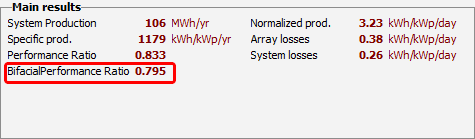
Finally, the same note as for regular PR applies: in systems with storage, time-step specific values of \(PR_\textsf{Bifi}\) are less meaningful because consumption can be delayed. This can lead to hourly or sub-hourly $ PR_\textsf{Bifi}$ values greater than 1. Data should be aggregated over a larger time scale for the PR to be meaningful.
Info
Whenever there are multiple sub-arrays, it may be the case that the bifaciality factor differs among them. A common example being that part of the system is monofacial while the rest is bifacial. In this case, PVsyst uses the convention that the system bifaciality factor is that of the whole system. This may lead to lower-than-nameplate values. See Bifacial systems results for more details.
Use of PR as in-site production assessment
The PR is an important metric in the PV industry and is often used as a contractual guarantee when commissioning a PV system or for verification of annual yield.
This is not an easy task, as the PR is not constant over the year, and the effective GlobInc value is not always available.
Weather-corrected PR
For short-term analysis (commissioning, one-week tests), a NREL paper proposes a "Weather-corrected Performance Ratio1", which has since been included in the IEC 61724-1 standard.
The objective is to eliminate seasonal variations in PR, primarily due to varying array temperature. Other weather contributions like irradiance level, wind velocity, varying soiling, etc are not taken into account in this approach.
The proposal is to define an average array temperature calculated as an average over all operating time steps in the year, weighted by the incident irradiance GlobInc.
Then for a specified period, the PRTemp is defined by the following equation:
Where:
E_Gridis the energy injected into the grid. In systems other than standard grid-connected,E_Gridshould be replaced by the energy effectively produced as defined in the summary table for other systems.GlobInc= incident irradiance at the simulation time step [ W/m² ]- \(G_\textsf{Ref}\) = 1000 W/m² (reference irradiance)
- \(\mu_{Pmpp}=\) Pmpp temperature coefficient of the PV module (negative value)
- \(T_\textsf{array} =\) Array (cell) temperature for a given simulation time step
- \(T_\textsf{array,weighted} =\) Average array temperature for the entire year, weighted by the
GlobIncvalue. This is namedTArrWtdin the program.
Mathematically, if \(T_\textsf{array,weighted}\) is calculated with the same data, the yearly $ PR_\textsf{Temp}$ value should approximately equal the yearly PR. However, it cannot be exactly equal because $ \mu_{Pmpp}\,(T_\textsf{array} - T_\textsf{array,weighted})$ is not the exact value during the simulation.
This was implemented in PVsyst version 6.74. However, the results are not entirely convincing because in most PV systems, other contributions are season-dependent.
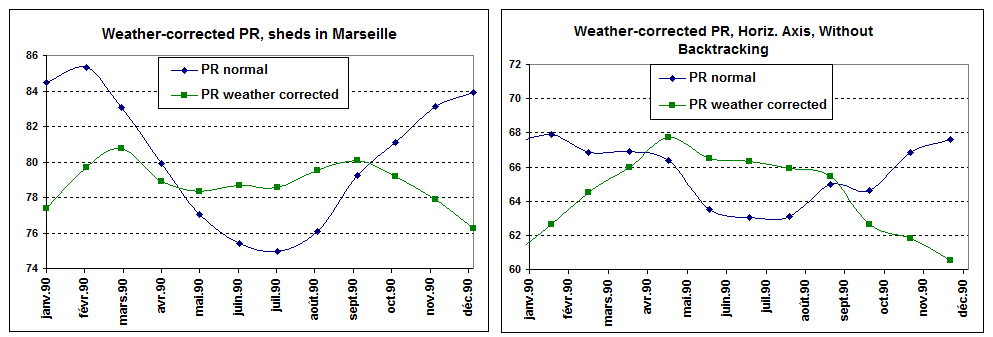
With shed-systems, applying this PR correction seems to over-correct the PR seasonal behaviour. This is due to the mutual shadings, which are more pronounced in winter.
This correction is almost unusable with tracking systems, as the seasonal variations due to tracking are largely dominating the temperature effect.
Therefore these results will be available on the report only when you ask it in the "Report Preferences", menu "Settings" in the Report editing window.
Model Updates
Previous to 8.0.12
Due to uncertainty in the IEC 61724-1 norm phrasing, the Bifacial Performance Ratio (\(PR_\textsf{Bifi}\)) didn't take the bifaciality factor \(\phi\) into account in PVsyst versions prior to 8.0.12. It was then given by the following formula (for standard grid systems):
-
T. Dierauf, A. Growitz (Sunpower Corp.), S. Kurtz (NREL), J.-L. Becerra Cruz (Fichtner), E. Riley (Black & Veatch), C. Hansen (Sandia National Laboratories)
Weather Corrected Performance Ratio
Technical Report NREL/TP-5200-57991, April 2013 ↩