P50 - P90 evaluations
The P50–P90 evaluation is a probabilistic approach for interpreting simulation results over several years. This requires several additional parameters that are not provided by the simulation and must be specified (assumed) by the user.
Warning
This feature is not available for stand-alone and pumping systems.
Statistical model
The PVsyst P90 tool assumes that, over many years of operation, the annual energy yields follow a normal (Gaussian) distribution, centered on your simulation result. The distribution is fully described by two parameters: its mean (μ), taken as the simulated yield, and its standard deviation (σ), which sets the spread and is obtained by combining all individual uncertainties in quadrature.
P50 and P90 are exceedance values: the annual production has a 50% probability of exceeding the P50 value and a 90% probability of exceeding the P90 value. In terms of percentiles, P50 is the median (the 50th percentile, equal to the mean for a symmetric normal distribution) and P90 is the 10th percentile. For a normal distribution, P90 lies 1.28 σ below the mean.
The dominant contributors to σ are the uncertainty and interannual variability of the weather data, though other uncertainties in the simulation inputs and process should also be accounted for.
Usage
You must first run a simulation, as the P50 value corresponds to the simulation output by default. To access the P50–P90 tool, click the Energy Management button and open the "P50–P90 estimation" page in the grid project dialog.
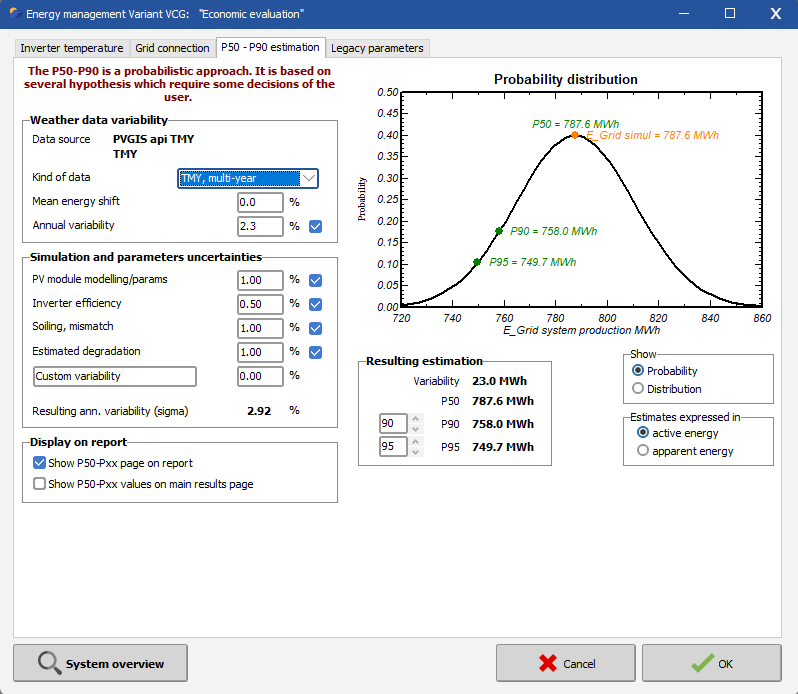
You must then specify all parameters contributing to the overall yield uncertainty:
- First select the
Kind of data, which affects how the P50 value is determined. - Then specify the shift, the weather data annual variability, and the other simulation uncertainties.
- Finally, you may specify whether you want P90 or other values. The result will appear on the report if the parameters are correctly specified (no warning).
Display options
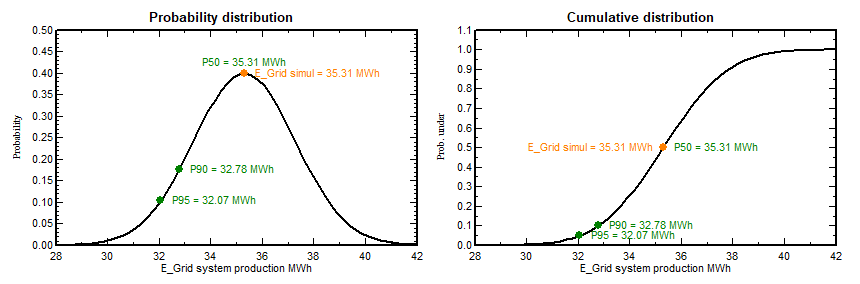
In the show box, you may choose to display your model either as a Gaussian probability distribution over several years or as the corresponding cumulative distribution (the integral of the Gaussian).
Parameter definition
All sources of uncertainty considered in the tool are assumed to be random and are added in quadrature, providing a global standard deviation used to construct the Gaussian distribution and estimate P90 or other P_xx_ values.
Weather file type
PVsyst automatically determines the kind of data for most known sources. If it is incorrect or missing, use the Kind of data drop-down menu to define which type of weather file you are using.
Weather data types fall into two categories:
- If the data represent an average over several years ("Monthly averages" or "TMY, multi-year"), the simulation result should be considered as an average and generally corresponds to P50 (the mean value of the Gaussian).
- If the data are for a specified year ("Own measured" or "Specific year"), they cannot be considered representative of the P50 value. Without additional information, you cannot determine a reliable P50–P90 indicator. However, if you know the site's typical long-term average, you can enter the
year deviation from averageto indicate how this particular year departs from it. This applies a percentage shift to the P50 value, moving it relative to the simulation result.
Weather variability
The Gaussian spread (resulting annual variability (sigma)) is dominated by the weather annual variability. This information can be obtained in several ways:
- Meteonorm versions 7.2, 7.3, 8.X, and 9.0 provide this information for your site (see the "site definition" dialog, "Monthly Meteo" page). When present, this value will be used automatically by PVsyst.
- Depending on the provider, an annual variability value may be included in a TMY weather file and used automatically by PVsyst.
- You may also compute annual variability yourself from a series of weather files and overwrite the default suggestion.
- When no value is available, PVsyst will compute a variability using our default model.
Simulation and parameter uncertainties
Additional uncertainties in the simulation process can be considered. These deviations should represent random year-to-year variability of the uncertainty, not the absolute uncertainty.
- PV module model and parameters (the main uncertainty after weather data)
- Inverter efficiency (negligible)
- Soiling and module quality loss (highly dependent on site conditions)
- Long-term degradation (not compatible with the P90 evaluation concept)
- Custom other contributions
Remarks
Weather data bias
The weather variability described above only captures the year-to-year fluctuation of the resource. It does not account for the uncertainty on the long-term average itself — that is, how accurately your weather file represents the true solar resource at the site. This long-term (measurement and model) uncertainty is what produces the large discrepancies observed between different weather sources. Its main contributors are:
- The quality of the ground measurements: operator care, sensor positioning, calibration and drift, and perturbations such as shading, dirt or snow on the sensors.
- A non-negligible horizon at the measurement site (terrestrial measurements).
- The distance between the project site and the measuring station (terrestrial measurements).
- The accuracy of the models used to interpret satellite data, which have been continuously improving over the past 20 years.
There is no general method for accounting for this type of bias in the PVsyst P90 tool. It is, however, recommended to run your simulation with data from several providers to gauge the potential bias in your weather source.
Climate change
The solar resource is not stationary over the long term. Worldwide radiation records show that the surface irradiance reaching the ground has undergone significant multi-decadal variations, commonly referred to as global dimming and brightening: a widespread decline from the 1950s to the 1980s, followed by a partial recovery (brightening) over Europe, the USA, and Japan, while other regions such as India have continued to dim 1. These trends are typically of the order of a few percent per decade — though strongly region-dependent — and are driven mainly by changes in aerosols (air pollution) and cloudiness. As a result, a weather dataset built from older measurements may no longer represent today's resource, and the long-term average itself can drift over the operating life of a plant.
PVsyst does not model these trends explicitly. A legacy parameter, Climate change (renamed mean energy shift since PVsyst 8.1.5), lets you shift the P50 value by a user-defined percentage relative to the simulation result. It was intended to compensate for a known bias in older average datasets, which tend to underestimate the current resource because of brightening. With modern weather data — which already reflects recent conditions — this correction is generally unnecessary and should be left at zero, unless you have a specific, quantified reason to apply it.
P90 for monthly or daily values
P50–P90 estimations are only meaningful for annual yields; defining a P90 for sub-hourly, hourly, daily, or even monthly totals is not statistically meaningful.
While the year-to-year variability of annual irradiation is typically 3–4% (RMS), the variability of individual monthly values is much larger, so building a probability profile month by month yields erratic results.
A reliable P90 also requires a long measurement record (at least 15–20 years) to be statistically significant. No generic monthly variability data of this kind exists, and any such figure would depend heavily on the local climate and the season.
If you nonetheless need a monthly evaluation, obtain 15 or more years of monthly weather data for your site and derive the probability distribution separately for each month.
Correction of hourly / sub-hourly values
A common mistake is to build a "P90 time series" by scaling every hourly or sub-hourly result by the ratio of annual yields (P90 / P50).
This is incorrect: under clear-sky conditions the system produces the same output regardless of the scenario. The difference between a P50 and a P90 year comes from the frequency and severity of poor-weather periods, not from a uniform reduction of every time step.
Some weather data providers also supply ready-made P90 (or other P_xx_) time series. The methodologies are documented by each provider, but the assumptions and uncertainty values differ between them, so check the provider's documentation before relying on a given P_xx_ series. Note also that these time series cannot be used in the P90 tool directly; instead, they serve to run a "P90" simulation.
-
Martin Wild, Yawen Wang, Kaicun Wang, and Su Yang. A perspective on global dimming and brightening worldwide and in china. Advances in Atmospheric Sciences, 43(2):281–294, April 2025. URL: https://doi.org/10.1007/s00376-025-4534-2, doi:10.1007/s00376-025-4534-2. ↩