Master Slave Operation
The simulation can handle Master/Slave operation.
In this mode, you must define the number of slaves (for example, 1 slave for one master and one slave, or 2 slaves for one master and 2 slaves).
If your sub-array does not use the Master/Slave feature, set NSlaves = 0.
Principle
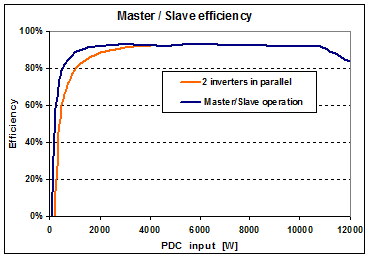
In this mode, the array is connected to the inputs of 2 (or more) inverters, but only one (the Master) performs MPP tracking on the array and transmits information to the other (the Slave).
The Master operates alone until the available array power exceeds a given threshold. Therefore, as shown on the graph, it operates better at low powers.
The gain is at most 1 to 2%, or lower with modern high-efficiency inverters; therefore, very few modern inverters support this mode.
Wiring
In normal (non-M/S) operation, you should always connect MPPT inputs independently (i.e., one array—a set of parallel strings—on one MPPT input) and never interconnect MPPT inputs unless MPPT tracking conflicts will occur.
Conversely, in Master/Slave operation, both inverters must "see" the full array; that is, you should connect the inverter inputs in parallel.
Internal Master/Slave
Many large MW-range inverters are assemblies of 100 to 200 kW units that internally operate in Master/Slave mode. From the outside, this improves the efficiency curve (which has a very sharp low-efficiency knee). However, the simulation must treat these devices as a whole, like a conventional inverter.
Therefore, the Internal Master/Slave notation in the inverter definition is purely informative and has no effect on simulation behavior.