Storage: Weak grid, islanding
This option concerns regions where the grid is not reliable (numerous cuts due to load shedding).
PV energy is stored in a battery and returned to the user when the grid is off. Technologically, this is far from straightforward, as typical grid-feeding solar inverters require the grid to be present to operate. There are several ways to address this problem, including:
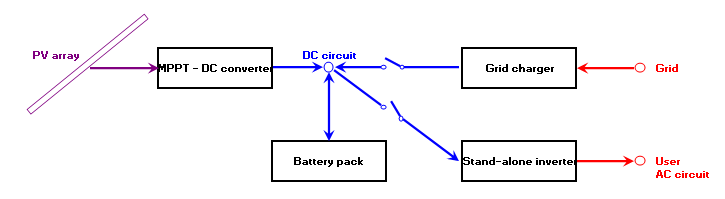
- The most simple: considering the internal battery system as a pure stand-alone system with an inverter for battery (Stand-Alone inverter). This will involve a battery charger from the PV system (MPPT => DC converter) and a Grid charger able to feed the battery system from the grid. This configuration doesn't allow to re-inject solar energy into the grid.
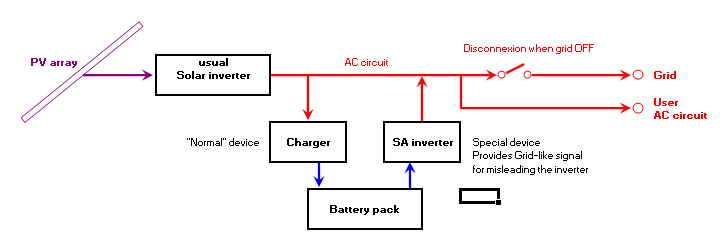
- Connecting the grid to the internal AC circuit and using a standard solar-to-grid inverter. This requires advanced technology with a special battery inverter (DC input) capable of "mimicking" the grid to manage the inverter. When the grid is down, a mechanical switch should physically disconnect the grid from the installation. In this situation, the system operates in islanding mode, with the battery inverter providing the full power required by user consumption. In connected mode, the user's AC circuit is directly connected to the grid. This allows solar excess energy to be injected into the grid, although this is not always permitted by the grid manager.
Energy flux control
A suited control manages the energy fluxes at each instant.
As for the Self-consumption storage case, there are several operating modes.
- When solar power is sufficient for user needs, the remaining power is used to charge the battery. If the battery is full, excess energy is injected into the grid if allowed; otherwise, this energy is lost (the inverter operates at reduced power).
- When solar power is insufficient (or at night), the user can be supplied by the battery. However, a storage reserve must be maintained for grid unavailability. Therefore, one DOD limit must be defined for using energy in any case, and another for supplementing the grid when it is down.
- In case of grid failure, the switch should immediately open, and the user will be supplied by solar energy plus battery through the stand-alone inverter.
- The control device must be able to limit the solar inverter's power if grid injection is not allowed.
Grid unavailability
First, you must define the grid unavailability. Two options are available: 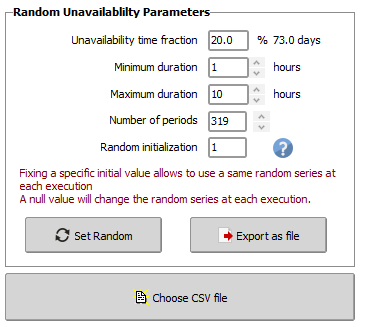
- Use the built-in tool to define random unavailability periods throughout the year. Set the unavailability fraction and minimum duration. Then set either a maximum duration or number of periods. If higher than 0, the random initialization value is used to generate the same unavailability pattern for a given set of inputs. Once ready, press Set Random to generate the profile. You can save the profile as a CSV file for advanced editing or archiving.
- Import the information from a CSV file using the standard interface by clicking on Choose CSV file
NB
Values read in the file will be interpreted as follows: - NOT available below or equal to 0.5 - Available above 0.5
Once the profile is defined, you will be able to display the result as individual periods 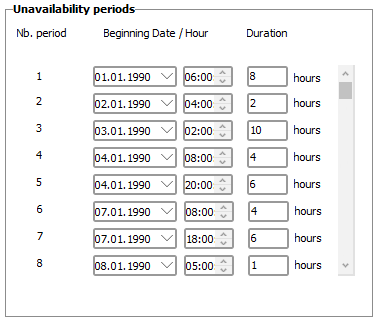
Or a graph: 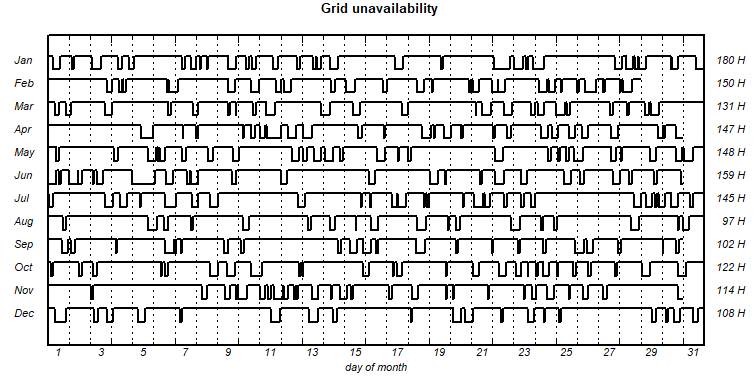
Sizing
Battery pack capacity is closely related to user needs. Ideally, the energy remaining below the high SOC level should cover the maximum demand during the longest unavailability period. You can reduce this capacity, but at the risk of supply failure.
Overall, the full battery capacity should cover at least 1 to 2 days of average consumption.
The solar inverter is sized as usual for grid-connected systems.
Simulation and results
Although the system architecture is quite different, the simulation process is similar to the self-consumption case.
After the simulation, the balances of all energy flows appear in the loss diagram:
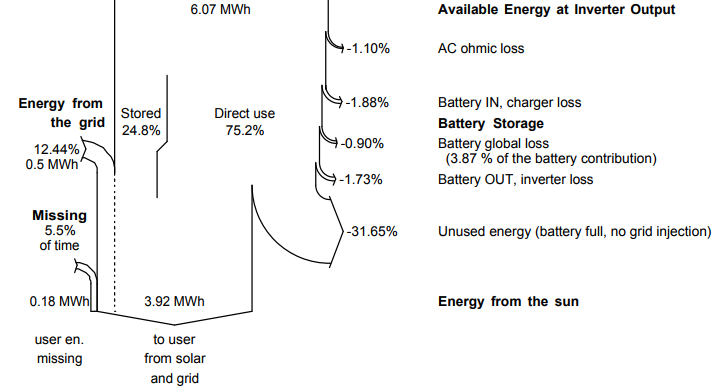
The diagram shows:
| The amount of stored energy (relative to direct use), which affects cycling—that is, battery lifetime and therefore the cost of stored energy. | |
| EUnused | Excess energy production that cannot be injected nor stored |
| CL_Chrg | Charger losses (AC-DC conversion) |
| EBatCh | Charging energy at the battery terminals. |
| EBatLss | The battery efficiency loss due to charging/discharging Faradaic efficiency, internal resistance, possible gassing (lead-acid), or overcurrent from overcharging, etc. |
| EBatDis | Discharging energy at the battery terminals. |
| CL_InvB | Battery inverter losses (DC-AC conversion). |
| E_User | The total energy needed by the user (i.e., the specified load profile) |
| E_Solar | E_Solar = E_User - EFrGrid - E_Miss. The user's consumption provided by the sun. Can be negative when the battery is charged by the grid |
| EFrGrid | The missing energy drawn from the grid when it is available |
| E_Miss | The missing energy when the grid is unavailable and the battery is empty. This results in a complete shutdown of user supply. |
| SolFrac | The "Solar Fraction"—the ratio of user energy from solar (E_Solar) to total user needs (E_User). |
| E_Grid | the excess energy from the PV array that cannot be stored in the battery and the grid is available. |