Storage: Power's peak shaving
For systems with DC:DC converters on the PV array: see Peak shaving with DC converters.
Principle
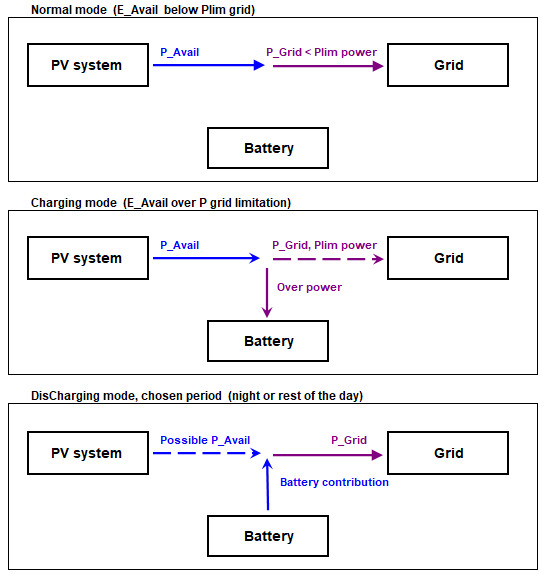
When the grid manager limits injection power, excess energy can be stored in batteries.
This offers the following advantages:
- For the PV plant owner: recovering energy that would otherwise be lost (at the cost of additional stored energy expenses).
- For the grid (at large scale): regulating renewable energy production.
To accomplish this, we need a battery pack capable of storing the excess power produced during one day, with a power rating higher than the specified limit.
In practice, if the limit is relatively high, storage will only be used episodically, representing a high investment for a low return.
To be significant for grid management, the limit should be relatively low, which requires a very large storage system. The cost of stored energy (especially from cycling) becomes critical to the PV plant's profitability.
This mode does not involve internal consumption: the energy flows are more straightforward.
Sizing
- Define the Grid Power Limit The maximum PV power at clear-sky conditions is displayed in the dialog. Choose a grid power limit below this maximum.
- Specify the Maximum Charger Power Set the charger’s maximum input power by subtracting the grid power limit from the maximum PV power at clear-sky conditions.
- Set Battery Inverter Power Battery inverter power can be lower than charger power, as discharge may extend into the night.
- Determine Battery Capacity Select a battery pack that ideally covers the peak excess energy on a clear day. You may choose a lower capacity for budget reasons. Run simulations to find the optimal size based on financial requirements, accounting for cycling degradation costs.
Simulation
The battery performs daily cycles: it is discharged at the end of each night and is charged on sunny days when there is excess PV generation.
After the simulation, the balances of all energy flows appear in the loss diagram:
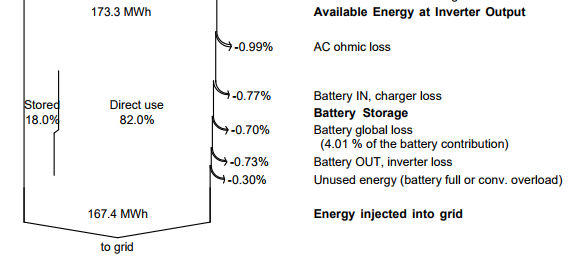
The diagram shows:
- EBatDis: The amount of stored energy, which has an impact on the cycling, i.e. the battery lifetime,
- EBatCh - EBatDis: The battery storage efficiency loss (faradic efficiency, internal resistance, gassing),
- CL_Chrg, CL_InvB: The charger and battery inverter's efficiency losses,
- EUnused: There may be some unused energy, either when the battery is full, or if the charging power overcomes the maximum power of the charger.
- E_Grid: The only use of the electricity in this mode.
We can observe that the only benefit of this configuration is to enhance the system's grid production when the PV array is highly oversized, at the cost of additional stored energy expenses.