Self consumption with storage
The self-consumption strategy with storage may serve different objectives:
- Consuming its own PV produced energy, and draw a minimum of energy from the grid, whatever the price.
- Optimizing the cost of the electricity. This is in the case of a high price of the electricity from the grid, and a low price of the re-injected energy. For being profitable, the difference should be higher than the price of the stored energy. If the tariffs are time-dependent during the day, this may involve a specific charging/discharging strategy, which is not yet implemented.
- For the grid management, re-injecting the energy when needed by the community. This is not possible to manage in the simulation, as the real state of the grid at each time is not known.
In this first implementation, only the first option is realized: energy is stored in the battery as soon as it is available (i.e., when PV production exceeds user needs) and is "immediately" used to satisfy internal needs until the battery is empty.
In this mode, battery energy is never reinjected into the grid. Keep in mind that user consumption and the grid use the same AC circuit. Practically, the control device and battery inverter must be able to modulate power to precisely feed user consumption.
If we define:
- E_Avail - energy available after all losses behind the inverter: E_Avail = EoutInv - EAuxLss - EUnavail - EAcOhmL - ETrfLss
- E_User - internal user needs (consumption), defined by the user's load profile
- E_Grid - excess PV energy injected into the grid
- EFrGrid - backup energy drawn from the grid
- EBatCh - energy stored in the battery
- EBatDis - energy drawn from the battery
We have the following operating modes:
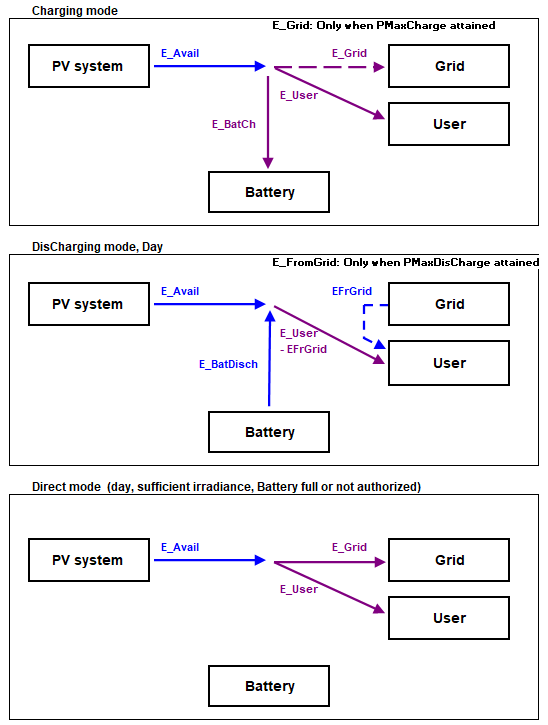
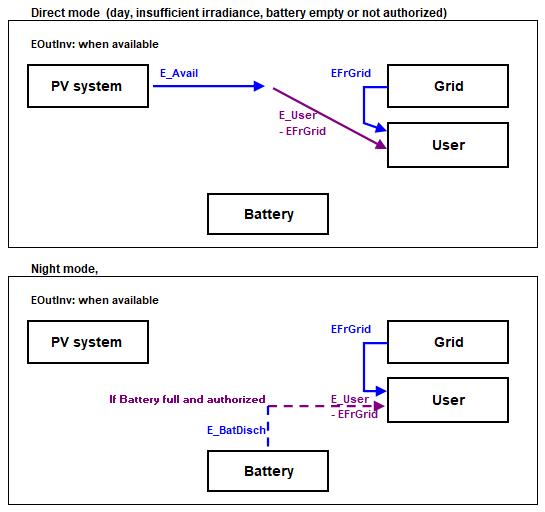
The charging or discharging are limited by the PMaxCharge of the charger, or the PMaxDischarge of the battery inverter.
Sizing
For a residential installation:
- First, evaluate the average daily energy needs from the user's load profile [kWh/day] (shown in the dialog).
- The PV array should be able to produce this energy for most days of the year.
- For effective independence from the grid, the battery pack should store at least 1 to 2 days of consumption, ideally 3 to 4 days.
Additional constraints apply to this sizing:
- Battery charging should not be too rapid: for lead-acid batteries, charging in 3 hours is the minimum reasonable for battery lifetime. Li-ion batteries support higher currents (down to 1 hour). This is limited by the charger maximum power. Any excess energy will be injected into the grid. If this is not desired, the maximum PV power [kWp] should charge the battery in 3 to 5 hours minimum.
- The inverter maximum power (at the battery output) must be sufficient to supply the maximum power required by the user. Additionally, the maximum discharge current should not be excessive (C3—that is, 3-hour discharge for lead-acid, or around C1 for Li-ion). If these powers are exceeded, battery capacity should be increased. This may occur when full daily consumption is concentrated in a short period.
Simulation and results
After the simulation, the balances of all energy flows appear in the loss diagram:
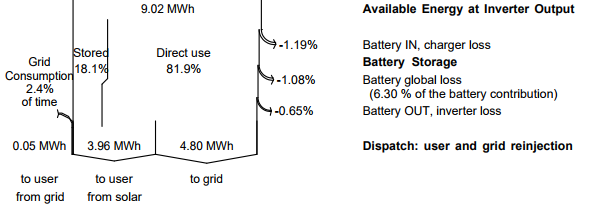
The diagram shows:
| The amount of stored energy (relative to direct use), which affects cycling—that is, battery lifetime and cost of stored energy. This is closely related to the user's load profile—specifically, whether energy is primarily consumed during solar availability or not. This can be improved through rigorous demand-side energy management (DSM)—that is, shifting appliance use from night to specific periods of the day. | |
| EBatCh - EBatDis | The battery energy loss due to charging/discharging Faradaic efficiency, internal resistance, potential gassing (lead-acid), or overcurrent from overcharging, etc. |
| CL_Chrg | The operating losses in the battery charger (inefficiency). |
| CL_InvB | The operating losses in the battery inverter (inefficiency). |
| E_User | The total energy consumed by the user (i.e., the specified load profile), which is divided into: |
| E_Solar | The user's consumption provided by the sun |
| EFrGrid | The missing energy drawn from the grid when PV production is insufficient (especially at night) |
| SolFrac | The "Solar Fraction"—the ratio of the user's energy from solar to total user consumption |
| E_Grid | The excess energy injected into the grid. This is essentially related to the PV array power to user consumption ratio. |
| E_Unused | The same energy quantity as E_Grid above when reinjection into the grid is not allowed. |
The relative values of the energies in this final balances are highly dependent on the sizing. This result should be a guide for optimizing the system according to your criteria.