Grid power limitation
General
A limit to the injected power is sometimes required by the grid manager.
For maximizing the annual yield, people often install an over-sized PV system (high DC:AC ratio), and accept some energy loss during the best hours of the year (peak-shaving).
In practice, power limitation cannot be applied at the injection point, since there is no device capable of absorbing excess power (i.e., dissipating it as heat). The limitation is instead applied at the inverter level, or more precisely at the PV array level. The only way to limit power is to not produce it—that is, to shift the operating point on the array I/V curve to draw only the necessary power. This is the inverter's function.
In the simulation
The objective is to define an inverter maximum power (Pnom eff) which should correspond to the Grid specified limit power (PNom grid), plus the AC losses after the inverter (wiring, transfos, auxiliaries, etc).
In previous versions (before V 7.3), this was done at the end of each simulation step by correcting all simulation calculations from EArray to the injection for the global system. This was not entirely reliable and sometimes produced unexpected behaviors with heterogeneous PV systems (different sub-arrays and PNom ratios).
Since version 7.3, the strategy has changed: the maximum power of each inverter (each MPPT) is evaluated at the beginning of each simulation step to respect the grid limitation.
This pre-evaluation must take several factors into account:
- The nominal power of each MPPT, taking temperature and power factor into account
- The possible power sharing predefined between MPPT inputs of inverters,
- The different charges of each MPPT input (some with N and some with N+1 strings),
- The possible self-consumption or battery charging for this hour should be added to the grid limit,
- The power sharing between different orientations on a same inverter should be taken into account,
- The grid limit may be specified as Active power [kW] or apparent power [kVA].
After defining the possible PNom of all MPPTs, PVsyst evaluates their sum Pnom(tot) and reduces some PNom values to match the required grid limit. The reduction begins with the most highly loaded MPPTs—those with the higher DC:AC ratio. This is the major difference from the previous calculation on the global system.
With this pre-evaluation of each PNom(eff), the simulation may be performed in the same way as usually. The excess energy will be accounted as "Inverter loss over nominal power".
If we want to separately evaluate the loss due to the "normal" Pnom of each inverter and the contribution of the grid limitation loss (named EUnused in the loss diagram), we must recalculate the yield of each MPPT at each step with its nominal PNom.
Procedure
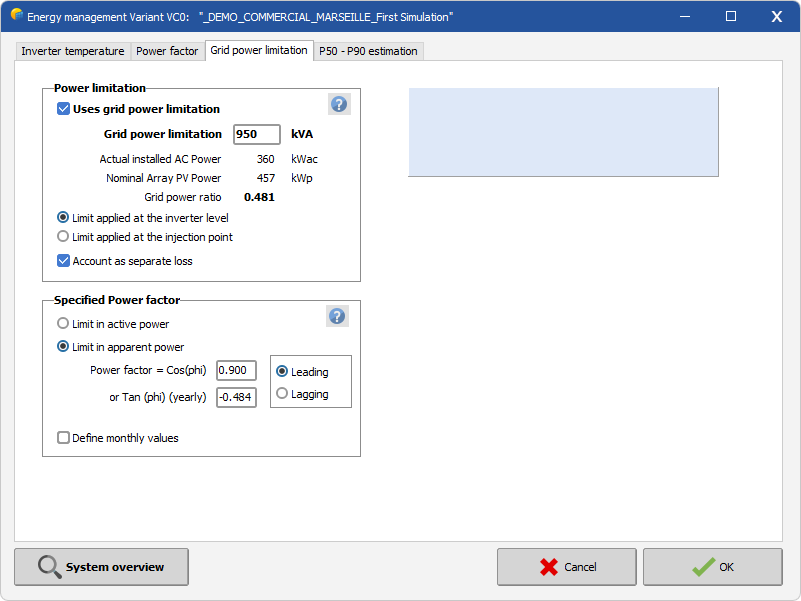
The grid limitation may be defined in the project's window, button Energy Management.
Here you can decide whether you have a grid limitation, and specify its value.
The limitation may be defined:
- either at the inverter level: the inverter power is limited to the rated value, and the power injected into the grid is further reduced by the losses defined after the inverter (auxiliaries, AC wiring, transformer).
- or at the injection point level: the maximum power delivered to the grid is indeed the rated limit, the inverter will have to deliver a higher power for compensating the losses after the inverter.
This limitation may be required:
- either as active power (expressed in kW),
- or as apparent power [kVA]: in this case the effective active power [kW] is limited at a lower value than the apparent power limit [kVA]. The Cos(Phi), specific for the grid limitation, may be specified in yearly or monthly values.
The limitation itself will always be managed by the inverter as a clipping loss.
When checking "Account as separate loss", the results will show separately the loss due to the inverter limitation itself, and the loss (named EGrdLim) due to the additional condition of grid limitation. This does not correspond exactly to the physical behaviour of the system, which will always clip at the inverter level, but it is meant to show explicitly the part of the clipping losses due to the injection limitation. When this choice is active, the output variable EOutInv, which usually gives the energy at the output of the inverter, will change slightly its meaning. It will no longer be the true power that one would measure at the inverter outputs, but rather the power that could be achieved if no grid limitation was present. This allows to have a coherent sequence of energy and loss values in the loss diagram.
The grid limitation can be defined as a constant value or based on a timeseries
Note on the grid limitation with storage
With grid storage it is harder to extract the energy lost due to the grid limitation cleanly, as the energy lost may be attributed to the battery or to the grid interchangeably: A bigger battery could have reduced the energy lost due to the grid limitation, but without grid limitation their won't be any losses in the first place.
| Grid limitation | Separate losses | |
| Inverter | ❌ | With AC-coupled BESS, the limitation happens before the BESS. |
| Inverter | ✅ | Option disabled, as moving the grid limitation from the inverter to the grid makes little sense, especially with batteries involved |
| Injection | ❌ | The pre-evaluation of each MPPT max power will sum the grid limitation and the battery charging power. For power shifting, this power will be as defined in the strategy for the current time step. For the other it will be based on the max charging power possible. If the battery is more limited than forecasted (max SOC is reached) the excess energy will be accounted for as EUnused |
| Injection | ✅ | Same as without "Separate losses", with the additional correction if system production is higher without grid limitation applied. Compared to a system without storage, EGrdLim (energy lost due to the grid limitation) is likely to be much smaller, since a big part of the limitation will be either absorbed by the battery or accounted for as EUnused |