Bifacial system: 2-dimensional unlimited trackers
For the basic principles of the bifacial simulation, please click here.
Important Hypothesis
This simplified 2D model is designed for large, regular tracking systems. For the modelling of the backside and reflected irradiances, a tracker array will be represented by a generic “Unlimited Trackers” configuration, i.e, with a single axis orientation, identical pitch between trackers and neglecting edge effects at the ends of individual trackers. Note that it also does not differentiate between PV-"sensitive" areas and non-"sensitive" frames. Therefore you can use it:
- either directly with a simplified geometry defined with the "Horizontal axis, Unlimited trackers" orientation type,
- or with a 3D model of the tracker arrangement, provided that each tracker array is sufficiently large and regular to be approximated by the "Unlimited trackers" hypothesis.
The application of the model is as follows:
- PVsyst will create an approximate "Unlimited trackers" geometry for each bifacial tracker orientation, just for the calculation of backside and reflected irradiances during the simulation.
- This geometric representation will try to match the 3D layout as closely as possible (the part corresponding to the same orientation).
-
- Prior to the simulation, the parameters of this "unlimited trackers" representation will by default be adjusted according to the 3D drawing.
- The height above the ground, however, is not extracted from the 3D scene. It must be specified manually in the bifacial model window.
- To compensate some limitations of the translation of the 3D drawing to a simplified geometry, the user can override the "number of rows" and "pitch" parameters. These will only impact the backside and reflected irradiances, not the front side calculations.
- Since the remaining geometric parameters (azimuth, tracker width, etc.) defined in the bifacial model window are overridden by the 3D scene, they can be considered exploratory parameters that can be used within the bifacial model window to observe how the bifacial model reacts to differing conditions.
2-dimensional calculation
The "unlimited trackers" hypothesis allows a simple analytical calculation of irradiances in a tracker array, namely the mutual shadings from tracker to tracker (or avoiding them via backtracking), considering only transverse directions (perpendicular to the axis).
The treatment of the different irradiances on the trackers is identical to the fixed tilt rows 2D model. The pre-calculation of the ground points (irradiance received, view factor integrals), is performed on 7 different trackers positions. Then the simulation will interpolate these values (using cubic splines) at each time step, in terms of the exact position of the trackers.
Note that no other shading elements from the 3D scene is considered for the backside irradiance calculation.
Tools
Similar tools as those for fixed tilt rows are available to study tracking systems. We can try to understand all the contributions and behaviors with different drawings in terms of different variables, especially the Tracker's positions, and the Ground-points positions.
In this tool, you can vary the tracker's parameters to analyze the effects.
Performances
The bifacial gain of tracking systems is expected to be slighty lower than for fixed tilt systems. Because the tracking strategy tends to optimize the trapping of sun rays, thus less beam irradiance reaches the ground.
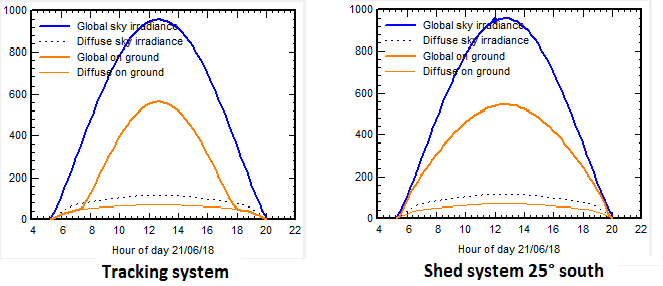
The next figure shows a comparison of the beam attaining the ground, for similar fixed and tracking systems (GCR = 41%):
We can observe that in the morning and evening, the beam acceptance is much lower for tracking systems, falling to null when the mutual shadings (or backtracking) begin.
In our case and for a clear day in June, the beam fraction on ground is 44% with tracking, and 60% with fixed tilt systems.
Other parameters may balance a part of this deficit: the view factor on the back side are similar. But the front gain, as well as the back diffuse irradiance from sky, are better. We can mention that there generally cannot be a "direct" beam contribution from the sky on the back side of trackers.