Rseries and Rshunt determination
The previous topic Model parameters besides Datasheets defines the resistances involved in the one-diode model.
This explains that the Low-light performance (relative efficiency) is determined by the RSerie, RShunt and RShunt(0) parameters.
When accessing the "Model parameters > Rshunt-Rseries" page in the PV module definition dialog, you are advised to select "Relative effic." to view the low-light behavior graph:
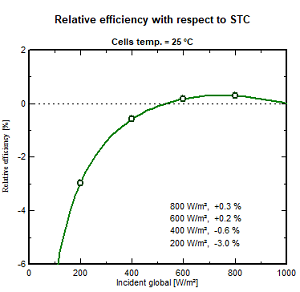
You can easily verify by adjusting the parameters that this low-light efficiency behavior depends on the 3 mentioned resistances:
- Increasing Rshunt will increase the low-light efficiency.
- Increasing RShunt(0) (on the next page "RShunt expon.") , will also increase the low-light efficiency
- Increasing RSerie also increases the Low-light performance.
Default values
- The Rshunt default value is based on STC parameters: it is 0.2 times the "conductance" defined by the MPP: Rshunt(default) = Vmp / (0.2 × (Isc – Imp)).
- The Rshunt(0) default value is 4 x Rshunt for Crystalline modules, and 12 x Rshunt for most other technologies (thin film).
- The Rseries default is set to achieve a relative efficiency at 200 W/m² = –3%.
- The RshExp exponential coefficient is always -5.5, according to all our measurements of Rshunt at 1 sun. This should not be modified.
The key point is that the primary default condition is based on the relative efficiency @ 200 W/m² = –3%. Rseries is adjusted to achieve this condition regardless of Rshunt and Rsh(0) values. Therefore, when adjusting these values, you typically do not notice that low-light behavior also depends on them.
Constraints between these values
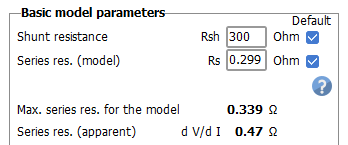
These variables are strongly interdependent.
- The Rseries cannot exceed the Maximum value (RSerieMax) shown on this dialog (here 0.339 Ω). This may limit the desired Low-light performance. |
- Rseries Max depends on the Rshunt value: it can be increased by raising Rshunt, but only to a limited extent (saturation), as shown in this example graph: |
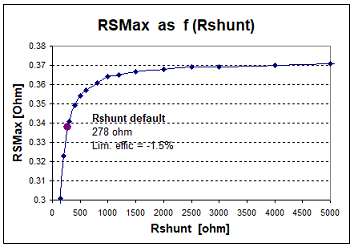
Therefore, if the desired relative efficiency cannot be achieved, you must increase Rshunt to increase Rseries Max.
Vmp/Voc ratio limitation
Rseries Max is also limited by the Vmp/Voc ratio at STC.
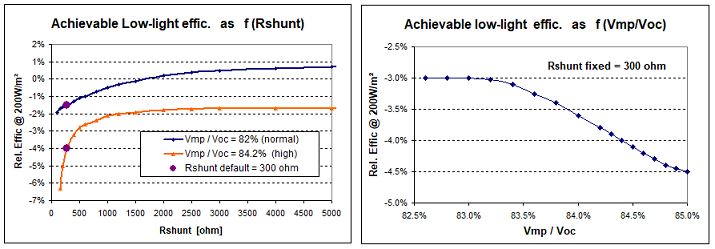
The next graph shows the evolution of Rseries Max, which decreases linearly but rapidly with the Vmp/Voc ratio. Note that a 50% decrease occurs with only a 3% increase in the Vmp/Voc ratio.
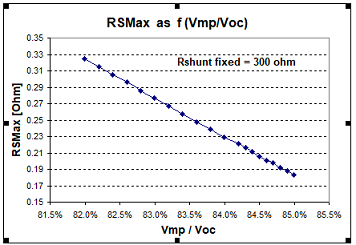
In practice, Vmp/Voc ratios greater than around 84% should be avoided.
Some manufacturers artificially decrease their Voc value, probably in order to increase the Fill Factor. We have sometimes observed values greater than 84% on the datasheet specifications, when the detailed measurements provided by an independent laboratory showed values below 82 or 83%.
The next graph shows examples of the possible low-light efficiencies as a function of Rshunt and Vmp/Voc.
Additional constraint: low temperature behavior
When Rseries approaches Rseries Max, the model's establishment leads to a very low diode saturation current (IoRef) and low diode ideality factor (Gamma, down to 0.92).
The diode saturation current Io varies significantly with temperature—by a factor of approximately 10,000 between +25°C and –10°C. Due to numerical issues with the exponential, PVsyst must set a lower limit on the temperature-dependent Io value. This limit is extremely low (0.01 pA), but when reached, the model's temperature behavior is compromised, and the muPmpp thermal coefficient changes sign.
When establishing defaults, PVsyst tries to push this limit below –10°C by increasing Rseries Max so that the appropriate default Rseries is not too close. This uses the same approach as previously: increasing Rshunt and possibly Voc if necessary.
Establishing the default values for RSerie and RShunt
When Rseries and Rshunt are not defined in the PAN file (in most cases), PVsyst must determine default values.
As mentioned previously, this default is characterized by low-light relative efficiency = –3% at 200 W/m².
The procedure is as follows:
- Rshunt is set to its default value according to STC.
- PVsyst tries to adjust Rserie for getting the required Efficiency.
- If this is not achievable, PVsyst increases Rshunt until this efficiency can be reached (up to 4 times the initial Rshunt).
- If this is still not achievable, PVsyst must increase the Voc value. The required increase is typically very small (a small fraction of a percent).
- Check of the Temperature coefficient muPmpp at -10°C. If this is positive, increases RSMax again, by increasing RShunt and possibly Voc.
This procedure is applied when reading the PAN file from the database if Rshunt and Rseries are not defined. You can also execute it by clicking the default buttons for Rshunt and Rseries.