Rs and Rsh effects on Low-light efficiency
The "Low-light efficiency" is mainly dependent on the Rserie and Rshunt (exponential behaviour) parameters (as well as di²MuTau for amorphous technology).
Rserie impact
The loss varies with the square of the current (\(Rs \times I^2\)), thus increasing quadratically with power.
Consider a module designed for irradiance below 100 W/m²: if Rseries is high (poor), the losses are higher at high irradiances (orange curve).
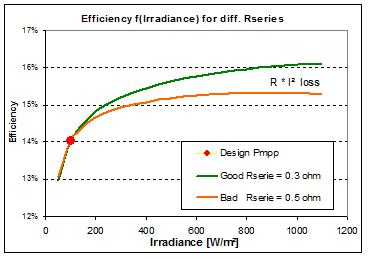
Now the characteristics of the module you buy is specified at STC.
Therefore, if you want to design a module with the same STC power as your "good" module, this new module with high Rseries will be overall better at low irradiances:
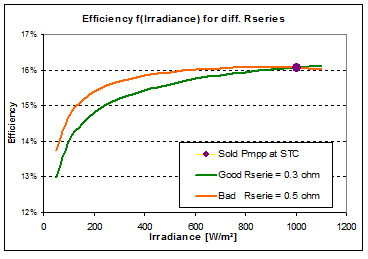
Therefore, a module with poor Rseries will exhibit better low-light performance.
Rshunt impact
The shunt resistance at STC has a very low impact on the Low-light efficiency.
However, the exponential behavior as a function of irradiance will decrease the Rshunt loss and thus enhance efficiency below 400 W/m².
The figure shows a crystalline module with a dynamic Rsh(0) / Rsh(STC) ratio of 4.
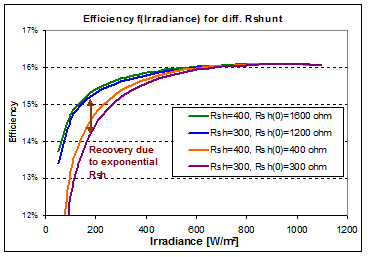
However, amorphous modules have much lower Rshunt at STC and a much higher dynamic Rsh(0) / Rsh(STC) ratio of approximately 12.
The figure shows that the efficiency difference between different Rshunt values would be significant if they were constant. However, the recovery due to exponential behavior leads to very similar curves.
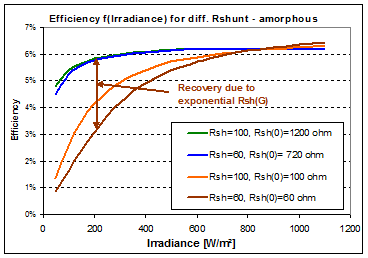
Therefore, recovery of low-light efficiency is better with low Rshunt values and high exponential dynamics.