Twin half-cut cells and shadings
Since 2014, an increasing number of manufacturers have proposed a new PV module configuration called "twin half-cut cell" modules.
These modules involve half-cells strings, mounted in the following way:
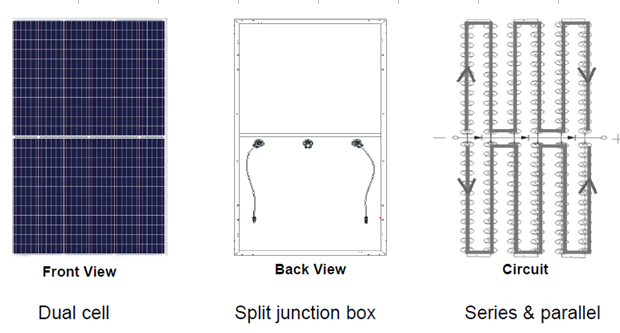
Electrically, these modules comprise 2 sets of 3 strings of half-cells connected in parallel. Each pair of strings shares the same bypass diode.
In the PV module definition (database), this should be specified as "Twin half-cells" layout, with 60 (or 72) cells in series and 2 strings in parallel.
Shadings calculation
One major expected advantage of this configuration is improved performance under partial shading due to reduced mismatch. These modules function as 2 half-modules stacked vertically. When the bottom half-module is shaded, the upper sub-module continues operating at half the total module current. This is the key point of the benefit of this configuration.
In a row arrangement, this is valid when modules are positioned in portrait. For landscape orientation, they will behave like standard modules.
In PVsyst, this situation may be taken into account in the calculation of the electrical shading losses.
Unlimited sheds
In the "Unlimited sheds" 2D calculation, where the electrical shading loss is considered complete as soon as the first bottom cell is shaded, we can simply consider loosing half the module instead of the full module width.
This means you can define the number of strings as 2 times the actual number of modules in the row width (i.e., the height of the half-module). However, you also must define the cell size as half that of a standard cell (approximately 78 mm).
Electrical loss "according to strings of modules"
In this option we have to define a rectangle-string as the area covered by a full string.
In a row arrangement, if we have one only string of twin modules in portrait, we can define rectangles representing half-modules (i.e. normal divided by 2). The calculation will be correct.
However in any other situation, if we have 2 strings in a row (U-wiring), or the shades are not regular (BIPV), this option is not useable.
Module Layout
Since the version 7, the twin half-cut modules are fully implemented in the Module Layout construction. The Module Layout calculation is correct in any case.
See the "Shading 3D calculation" page for the details of the calculation of one module. In the array I/V construction, we will accumulate the I/V curves of each module, not sub-modules.
Other advantages of Twin Half-cuts cells modules
Manufacturers claim several additional advantages to this technology.
Busbars resistive loss
Since the current in each string is halved, the resistive loss in the busbars is reduced by a factor of 4.
This results in a few percent increase in STC power, allowing the same module to move to a higher power class. This is an advantage for the manufacturer, as it increases the sellable STC power.
However, under low-light conditions (@ 200 W/m², the current is divided by 5, and power loss by 25), there is no gain. Therefore, the relative low-light performance of the module is reduced. This is a disadvantage for the customer.
Durability
Because the cells are smaller, they are less fragile and less susceptible to cracks.
Manufacturers claim that the durability of these modules is improved.