Hot spot and Submodules
In crystalline PV modules, cells are mechanically arranged in rows (in most modern modules: 6 rows of 10 or 12 cells):
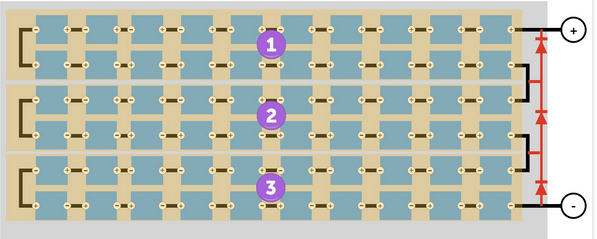
All the cells are connected in series. Therefore electrically we have 60 (or 72) cells in series, in one "string".
Sub-modules
In this PV module, we call "sub-module" the series of cells protected by a bypass diode. In this particular modules we have 3 sub-modules of 20 cells each, disposed in length (mechanically 2 x 10 cells).
The main role of the by-pass diodes is to protect the cells against the "Hot-spot" problems. See below.
In a shaded sub-module, the current is limited to that of the least illuminated cell. Therefore, the I/V curve of the sub-module is nearly identical regardless of how many cells are shaded. Only the reverse-biased I/V behavior changes slightly. This is the reason why the sub-module is the basic unit for electrical shadings calculation.
NB: In the "Twin half-cut cells" technology, we consider that we have 6 sub-modules, each of 60 (72) half-cells in series. The by-pass diodes are shared between 2 sub-modules.
Hot spot problem
When operating in sunlight, if one cell is shaded, its current is limited, and the current from other cells can induce a dangerous reverse current through it.
The shaded cell will absorb the reverse current (at high voltage) and heat up. This is called the "hot-spot" problem.
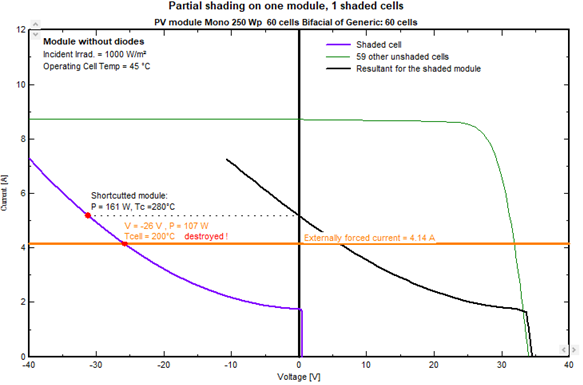
When the current imposed by the rest of the array significantly exceeds the short-circuit current Isc of the shaded cell, this current must be bypassed to limit the current in the shaded cell.
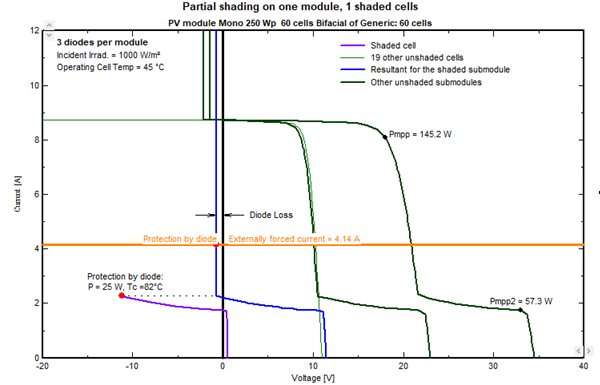
This is the role of bypass diodes, which are connected across each group of cells. When the voltage becomes negative, the bypass diodes become active and prevent it from becoming too negative, keeping the voltage across the shaded cell limited to a safe value.
The main purpose of bypass diodes is to protect the module against dangerous hot-spot problems.
In practice, you should have at least one diode for approximately 20–24 cells in series (that is, 3 diodes in 60 or 72 cell modules). A 96-cell module should be equipped with 4 bypass diodes.