Amorphous modules: Spectral correction
The reference irradiance used for simulation (the weather data values) includes the full spectrum from 305 nm (UV) to 2800 nm (IR). It is usually measured with pyranometers, which have a practical flat response over this whole interval.
However, each PV technology is characterized by a spectral sensitivity curve. While Si-crystalline can use photons below 1100 nm (corresponding to Egap = 1.12 eV), photons must have a minimum energy of Egap = 1.7 eV (730 nm) to create electron-hole pairs in amorphous silicon. Therefore, the photo current should be evaluated using a convolution integral between the incident spectrum and the spectral sensitivity. We will call "Utilization Factor" (UF) the value of this integral, which represents the fraction of the spectrum effectively useable for generating photo current.
Nevertheless, the spectral content of the solar radiation varies with the meteorological conditions and the humidity/aerosols of the atmosphere, etc. And of course PVsyst has no access to spectral measurements for a specific location or condition.
To estimate the Isc current at any given moment, CREST at the University of Loughborough1 proposes a two-phase procedure: first, characterizing the spectrum using a suited parameter, which could be evaluated from available environmental parameters, and then determine a correlation between this parameter and the spectral sensitivity of the concerned technology.
The chosen parameter is called "Average Photon Energy" (APE), and is obtained by dividing the irradiance [W/m² or eV/m²/sec] by the photon flux density [number of photons/m²/sec]. From detailed spectral measurements over one year, CREST has deduced a parametrization of this quantity according to air mass and "clear day" clearness index. Until further measurements are available elsewhere, we can reasonably assume this parametrization is valid at least for European climates.
The second phase is to determine a correlation between the UF, calculated for each measured spectrum for a given technology, and the APE. It is found that they are quite well correlated, and lead to a simple quadratic expression. The final amorphous spectral correction UF is shown on the figure.
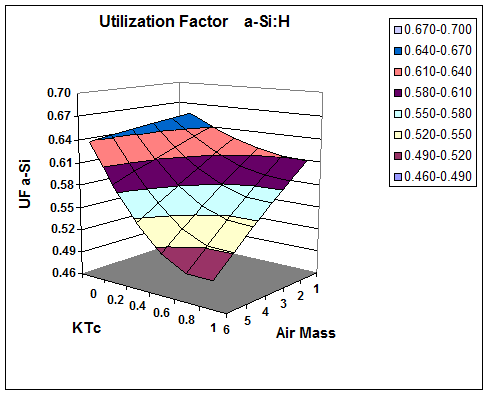
It varies from approximately 0.5 (APE=1.45) to 0.65 (APE=1.70), representing a range of about 30%. It can be seen that the response of amorphous modules, by clear weather, decreases significantly when air mass increases (winter, morning and evening). But it remains rather good by cloudy conditions (lower Ktc).
Finally, the final spectral correction used in PVsyst must be renormalized to the UF of the reference conditions used to establish the model (STC: AM 1.5 spectrum, corresponding to APE = 1.6 eV). This is the reason why the program will ask for the conditions in case of specifications based on outdoor measured data.
For our 3-month measurement campaign, the spectral correction calculated from this parametrization appears as follows:
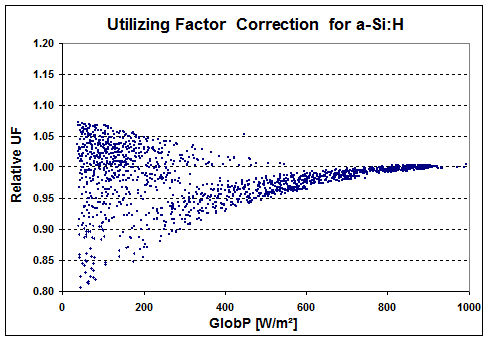
where we clearly identify the clear sky conditions, and the sensitivity enhancement for cloudy conditions (but acting on low-power hours!).
NB: Under the same conditions for crystalline modules, the UF varies between approximately 0.81 and 0.91, indicating better utilization of the full spectrum. But applying this correction to the measured data doesn't improve the results of the model.
-
T.R. Betts, R. Gottschalg, D.G. Infield
Spectral Irradiance Correction for PV system Yield Calculations.
19th European Photovoltaic Solar Energy Conference, Paris, June 2004. ↩