Low-light measurements and studies
The determination of Rseries and Rshunt is based on the behavior of the PV module in low-light conditions.
As mentioned in the Parameters besides Datasheets section, testing laboratories typically provide flash-test measurements according to the IEC 61853 standard. This requires to provide the basic data of one operating point (Isc, Voc, Imp, Vmp) for at 23 different Irradiance and temperature conditions:
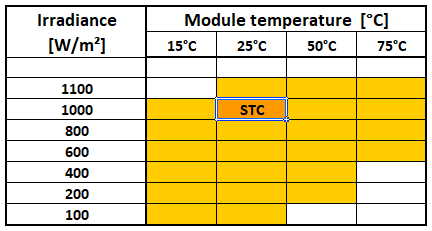
Analyzing procedure
In the PV module definitions dialog, PVsyst offers the opportunity of importing such data in a specific tool, for analyzing the measured data from a representative PV module.
The objective is to find a model behaviour matching the measurements at best, mainly concerning the low-light efficiency curve.
This tool is implemented within the dialog of a "normal" module, defined by its commercial data from datasheets (tab "Additional data > Measured Low-light data").
This measured module is constructed independently from the "parent" module, as its parameters (namely the STC values [ Isc, Voc, Imp, Vmp ] at 1000 W/m², 25°C) are the measured ones, which obviously differ from the "parent" module values.
In practice, manufacturers typically provide a laboratory report for one module type (3 identical samples according to IEC 61853) to represent all power classes of a given model.
The tool determines the parameters (Rseries and Rshunt) suited to match the low-light measured data, using a one-diode model established from the STC values of the measured module. This optimization may be done either on the full data set, or just for the points measured at 25°C.
For the characterization of modules in the database - when we avail of a detailed measurement report from an independent laboratory - we only use the measurements at 25°C, for several irradiances. So that we can determine the Rserie leading to the best fit with the data points.
Then, the problem is to transfer this information to the "parent" module. The Rshunt and Rseries determined here are not directly transferable, as they closely depend on the STC values. We must "transfer" the low-light behavior, meaning we search within the parent module for the Rseries that best matches the low-light curve.
ISC linearization
In the flash-tests measurements, the different irradiances are obtained by filters. The accuracy of the relative efficiency measurement is directly linked to the accuracy of the filter: an error of 1% on the filter calibration leads to an error of 1% in the relative efficiency.
We may evaluate the Irradiance measurement errors by supposing that the ISC is quite proportional to the irradiance. With this hypothesis we may "recalibrate" the irradiance measurement. We have observed that in some laboratories, the filters at 200 W/m² and 100 W/m² are over-evaluated by 1-2% or more: this strongly biases the low-light performance fit. Therefore this tool provides a way of linearizing the Isc/GRef values of each point.
Global fit
Most laboratories provide the PVsyst one-diode parameters by fitting the five "uncertain" parameters using the 23 measured data points. These five parameters are Rserie, Rshunt, Rshunt(0), RShuntExp, muPmpp.
However, fitting 5 parameters to only 23 data points is inherently uncertain. Especially when:
- The equations are so non-linear,
- The measured points are known with rather high uncertainties,
- Some parameters are not truly significant and may take nearly any value in the fit.
For example, the exponential parameter RshuntExp was explicitly measured on many I/V curves under direct sunlight for numerous modules over months or years. This was consistently close to -5.5 across all technologies. However, in these fits, the parameter may take values of 12 or more (flat behavior with irradiance) or very low values (nearly linear between Rshunt and Rshunt(G=0)).
Therefore, this fit can be very unstable: intermediate values show peaks and valleys, and even small variations in one data point can lead to significantly different solutions.
Furthermore, the STC values of the "parent" module differ, making it very problematic to adapt these parameters to another dataset.
This is especially problematic when adapting data to modules of different power classes. Some practitioners scale the data points and refit, but the justification for this approach is unclear.
We also observed that the fitted temperature behavior muPmpp from this global fit may differ significantly from the direct measurement at 1000 W/m² and 25°C as specified on the datasheets and from direct measurements.