Perez transposition model
The Perez model is a sophisticated model requiring good (well-measured) horizontal data (cf. Perez, Ineichen et al.1).
Model definition
The transposition is calculated separately for each irradiance component:
-
The beam component involves a purely geometrical transformation (cosine effect), which doesn't involve any physical assumption.
\[ \mathsf{BeamInc} = \mathsf{BeamHor}\, \frac{\cos \mathsf{AngInc} }{\sin \mathsf{HSol}}\,. \]This is the same as in the Hay model2.
-
To calculate the diffuse component, the Perez model introduces three sky components: the isotropic diffuse, the circumsolar irradiance, and the horizon band. Each is transformed based on different geometrical properties. Furthermore, the magnitude of each of these components is determined according to correlations established on the basis of data from several dozen measurement sites distributed all over the world.
The diffuse components can be expressed as: $$ \mathsf{DiffInc} = \mathsf{DiffHor}\,\bigl[(1- F_1) (1 + \cos \theta) / 2+ F_2 \sin\theta\bigr]\,,\ \mathsf{CircInc} = \mathsf{DiffHor}\,F_1\,\frac{\cos \mathsf{AngInc}}{\max (\sin 5°, \sin \mathsf{HSol})}\,. $$
The horizon band is included in \(\mathsf{DiffInc}\). The Perez coefficients \(F_1\) and \(F_2\) are further defined as:
\[ F_i (\varepsilon)= F_{i1}(\varepsilon) + \Delta\, F_{i2}(\varepsilon) + z\, F_{i3}(\varepsilon)\,, \]where \(\varepsilon\) is the sky-clearness coefficient and \(\Delta\) is the sky-brightness coefficient, and the dependence on \(\varepsilon\) is discretized into 8 bins. This yields an effective 48 coefficients to cover all sky-clearness bins.
-
The albedo component is evaluated in the same manner in both models, as a given fraction (the "albedo coefficient") of the global, weighted by the spherical wedge defined between the horizontal and the tilted plane extension (i.e. the half sphere complement of the "seen" sky hemisphere), which is the fraction \((1-\cos\theta)/2\) of the half-sphere.
\[ \mathsf{AlbInc} = \rho\; \mathsf{GlobHor}\,(1 - \cos \theta) / 2\,. \]
Sub-hourly implementation
It has been shown in several publications, including our own3, that using the Perez 1990 model coefficients at lower time scales induces a bias in the transposed irradiance GPOAI.
To verify this more robustly, we have applied the model on a dataset used by the IEA-PVPS group, which was subjected to thorough quality control 4 and includes minute GHI and DHI data from 113 sites across the globe. The results show overall lower transposed irradiances when applying the model at shorter time steps.
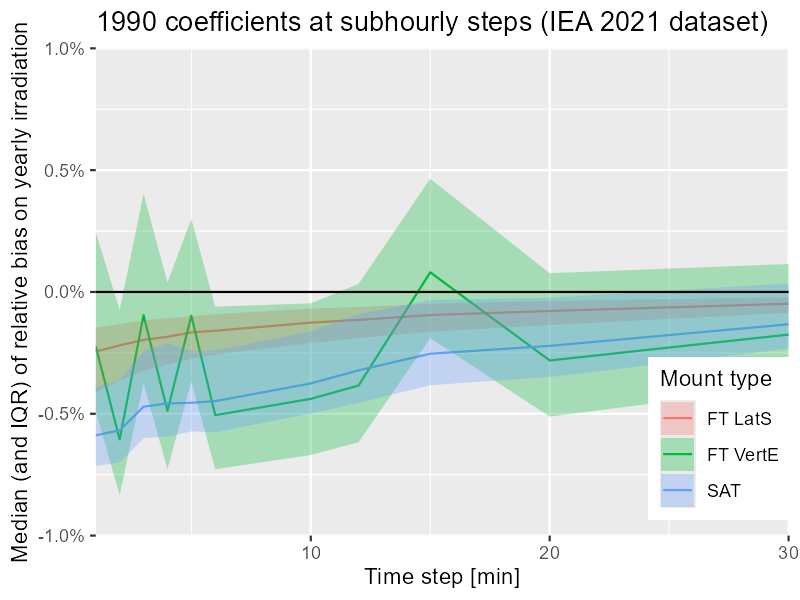
In the above figure, the Perez model applied on hourly steps is used as a reference. An argument can be made that a longer time step is more consistent with the dataset used to fit the 1990 coefficients (60 to 15-minute data). Bias is thus understood as a deviation with respect to that reference.
However, further inquiry shows that the transposition of the direct component, which is independent of the Perez coefficients, also leads to different results when applied on different time scales. There are some reasons to think that the short time scale transposition is to be preferred for the direct component, as it is only geometrical.
To reduce the discrepancy between hourly and sub-hourly transposition transformations, in 3 we proposed a methodology that is now used to define a new coefficient set for several sub-hourly time steps (integer divisors of 60 minutes). This coefficient set is based on the dataset4, which was used to fit Perez coefficients using the hourly transposed diffuse components as a reference. The aim is to reduce the bias due to using the 1990 coefficients.
With these new coefficients (which consist of a 48-coefficient set for each integer divisor of 60 minutes), the discrepancy does not disappear but is greatly reduced for different mount types. The dependence on the time resolution has mostly disappeared. Our current understanding is that the remaining discrepancy can be attributed to the direct component.
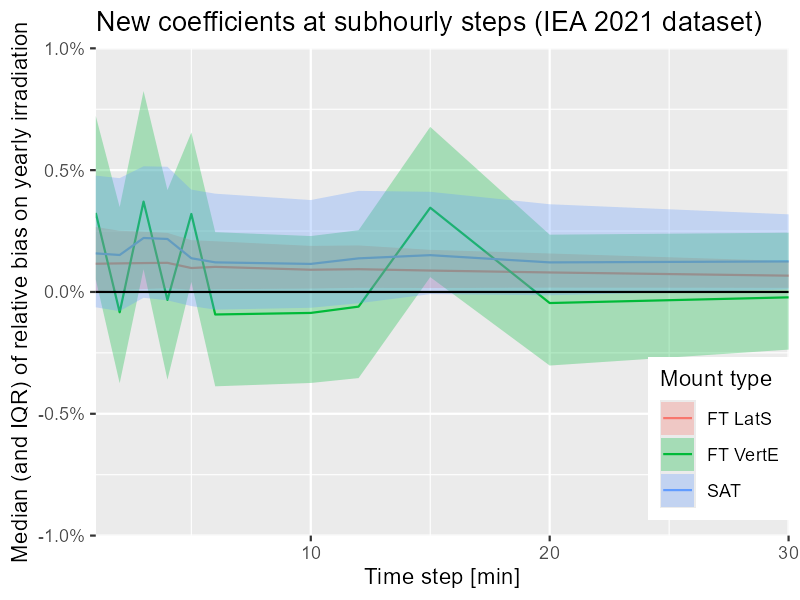
The new coefficients are used for sub-hourly simulations starting with PVsyst 8.1.0.
This situation could be improved more directly with a new, diverse, high-quality dataset of POA, GHI, and DHI. This work is left for a later update.
Cutoff for low sun heights
PVsyst applies a cutoff for low sun heights \(\mathsf{HSol} < 2°\). In such a case:
-
R. Perez, P.Ineichen, R. Seals, J. Michalsky, and R. Stewart. Modeling daylight availability and irradiance componentfrom direct and global irradiance. Solar Energy, 44(5):271–289, 1990. ↩
-
John E. Hay and J. A. Davies. Calculations of the solar radiation incident on an inclined surface. In John E. Hay and K. Won Thorne, editors, Proceedings: First Canadian Solar Radiation Data Workshop. Ottawa, Canada : Supply and Services Canada, 1980. URL: https://archive.org/details/proceedingsfirst00cana/mode/2up. ↩
-
Michele Oliosi, Bruno Wittmer, André Mermoud, and Agnes Bridel-Bertomeu. Accounting for sub-hourly irradiance fluctuations in hourly performance simulations. 40th European Photovoltaic Solar Energy Conference and Exhibition, 2023. doi:10.4229/EUPVSEC2023/4DV.4.43. ↩↩
-
Anne Forstinger, Stefan Wilbert, Birk Kraas, Carlos Fernández Peruchena, Chris A. Gueymard, Elena Collino, Jose A Ruiz-Arias, Jesús Polo Martinez, Yves-Marie Saint-Drenan, Dario Ronzio, Natalie Hanrieder, Adam R. Jensen, and Dazhi Yang. Expert Quality Control of Solar Radiation Ground Data Sets. In Proceedings of the ISES Solar World Congress 2021, 1–12. International Solar Energy Society, 2021. URL: http://proceedings.ises.org/citation?doi=swc.2021.38.02, doi:10.18086/swc.2021.38.02. ↩↩