Diffuse Irradiance model
When diffuse irradiation is not directly measured, it should be estimated from global horizontal or plane-of-array irradiances using a model. This is, for example, the case for satellite weather data, for which the diffuse component is modeled based on the input global horizontal irradiance series. This is also the case for ground-based measurements when a single pyranometer is used. A wide variety of models exist in the literature, with several candidates having similar accuracy1.
For example, Meteonorm2 uses the DirInt model to estimate the diffuse component3, which is also sometimes referred to as the "Perez diffuse model" (but not to be confused with the "Perez transposition model").
For custom weather data imports, PVsyst uses the following choice of diffuse irradiance model:
- Until version 8.1, the Erbs model4 was solely employed.
- Since version 8.1 and the arrival of sub-hourly simulation, the ENGERER2 model5 is employed, for which we recalculated the coefficients to improve its accuracy on a large dataset (see below).
An important requirement for our model selection is that it needs to rely on inputs that are generally available to perform PV simulation. The following models all use GHI as well as longitude, latitude, and time stamps to compute the solar geometry.
In the case where only POA measurements are available, the diffuse irradiance model is used in combination with a transposition model to reconstruct GHI and DHI.
Erbs model
The Erbs model4 is a simple yet effective correlation function of the ratio DHI/GHI vs. the clearness index. It is similar to the Liu and Jordan correlation6. It is given by the following piecewise equation:
The Erbs model was originally fitted using hourly ground-measured irradiance data from four U.S. locations4 and has a reasonable precision for hourly simulation. However, its precision is known to degrade for sub-hourly timescales7. For example, it cannot represent well the fast dynamics of cloud irradiance enhancement, for which \(K_t\) values above 1 can be measured due to momentary increases in diffuse irradiance. Therefore, other models should be used for sub-hourly timescales (see below) in order to properly account for those phenomena.
ENGERER2 model and PVsyst coefficients
The ENGERER2 model5 uses the same original inputs as the Erbs model, i.e. GHI, longitude, latitude, and time stamps, to estimate DHI. However, unlike the Erbs model, which uses solely the clearness index \(K_t\) as an intermediate variable, it relies on additional indicators of the weather conditions, which are:
- \(K_{tc} = \mathsf{GHI_{cs}} / \textsf{EHI}\), which is the clearness index for the clear sky global horizontal irradiance \(\mathsf{GHI_{cs}}\),
- \(\Delta K_{tc} = K_{tc} - K_t\), representing the variation between the previous indices,
- \(K_{de} = \mathsf{max}\left(0, 1 - \mathsf{GHI_{cs}} / \textsf{GHI} \right)\), intending to capture cloud-enhancement features.
Those indices are combined with the apparent solar time (AST) and the solar zenith angle (\(\theta_z\)) in the following formula to calculate the ratio of diffuse to global irradiance:
where \(C, \beta_0, \beta_1, \beta_2, \beta_3, \beta_4\), and \(\beta_5\) are fitting coefficients.
Since the last publication of the model5, larger datasets of 1-minute ground-measured global and diffuse irradiances have been made available, such as the 113 worldwide stations published by the IEA-PVPS8. Our implementation proposes a refit of the ENGERER2 coefficients based on the latter dataset, in order to minimize the yearly bias of the model worldwide.
Models comparison
Here we compare the accuracy of the different irradiance models described above in reproducing measured diffuse horizontal irradiance from global horizontal irradiance. We perform this comparison on the previously mentioned dataset8 by comparing, for each model, the mean annual bias error averaged over all the stations in the dataset (MBE). We perform this comparison for varying time-step durations, to highlight the better suitability of some models for sub-hourly simulations:
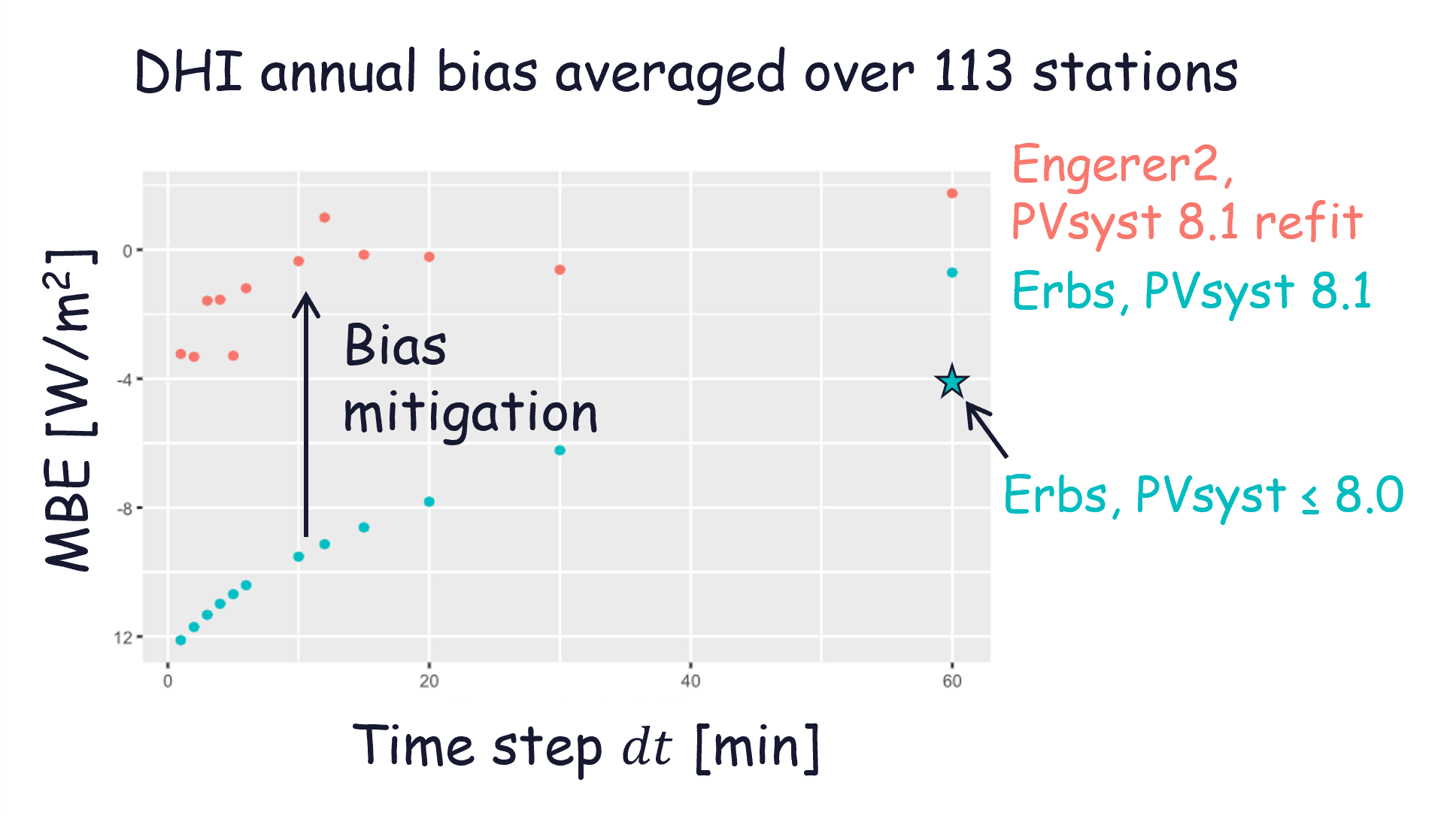
The Erbs model indeed creates an increasing bias as the time-step duration is reduced. This inaccuracy is strongly mitigated by using the ENGERER2 model. The latter model also performs well at hourly timescales.
We also indicate, as a reference, our historical implementation of the Erbs model (star symbol) for PVsyst versions prior to 8.1, which created a small bias of \(-4 ~\mathsf{W/m^2}\) for hourly simulations. This corresponds to approximatively \(1-2 ~\%\) of Geneva's average global irradiance (by day). This was due to an inconsistency between the timestamp definition in PVsyst and the one used in the definition of the Erbs model4, resulting in the sun's position being computed in the middle of the 60-minute interval instead of at the beginning. With this correction, the Erbs model performs remarkably well for hourly simulations, despite the comparison being carried out on a much larger dataset than the one it was originally fitted on.
-
Manajit Sengupta, Aron Habte, Stefan Wilbert, Christian Gueymard, Jan Remund, Elke Lorenz, Wilfried van Sark, and and Adam R. Jensen. Best Practices Handbook for the Collection and Use of Solar Resource Data for Solar Energy Applications: Fourth Edition. Technical Report, IEA PVPS, October 2024. URL: https://iea-pvps.org/key-topics/best-practices-handbook-for-the-collection-and-use-of-solar-resource-data-for-solar-energy-applications-fourth-edition/ (visited on 2026-04-15). ↩
-
Meteonorm documentation. URL: https://docs.meteonorm.com/knowledge/climate/tmy-process (visited on 2026-04-15). ↩
-
Richard Perez, Pierre Ineichen, E. L. Maxwell, R. D. Seals, and A. Zelenka. Dynamic global-to-direct irradiance conversion models. ASHRAE Transactions, 98:354–369, 01 1992. ↩
-
D.G. Erbs, S.A. Klein, and J.A. Duffie. Estimation of the diffuse radiation fraction for hourly, daily and monthly-average global radiation. Solar Energy, 28(4):293–302, 1982. doi:10.1016/0038-092x(82)90302-4. ↩↩↩↩
-
Jamie M. Bright and Nicholas A. Engerer. Engerer2: Global re-parameterisation, update, and validation of an irradiance separation model at different temporal resolutions. Journal of Renewable and Sustainable Energy, 11(3):033701, May 2019. URL: https://pubs.aip.org/jrse/article/11/3/033701/284883/Engerer2-Global-re-parameterisation-update-and (visited on 2025-11-05), doi:10.1063/1.5097014. ↩↩↩
-
Benjamin Y.H. Liu and Richard C. Jordan. The interrelationship and characteristic distribution of direct, diffuse and total solar radiation. Solar Energy, 4(3):1–19, July 1960. doi:10.1016/0038-092x(60)90062-1. ↩
-
R.A. Gansler, Klein S.A., and W.A. Beckman. Investigation of minutes solar radiation data. Solar Energy, 1995. doi:10.1016/0038-092X(95)00025-M. ↩
-
Anne Forstinger, Stefan Wilbert, Birk Kraas, Carlos Fernández Peruchena, Chris A. Gueymard, Elena Collino, Jose A Ruiz-Arias, Jesús Polo Martinez, Yves-Marie Saint-Drenan, Dario Ronzio, Natalie Hanrieder, Adam R. Jensen, and Dazhi Yang. Expert Quality Control of Solar Radiation Ground Data Sets. In Proceedings of the ISES Solar World Congress 2021, 1–12. International Solar Energy Society, 2021. URL: http://proceedings.ises.org/citation?doi=swc.2021.38.02, doi:10.18086/swc.2021.38.02. ↩↩