Extraterrestrial irradiance and clearness index
Extraterrestrial irradiance
The extraterrestrial irradiance, i.e. the irradiance outside the atmosphere, is generally described as a sinusoidal function with a \(3.3\%\) amplitude over the year, to take into account the Earth's orbital ellipticity: $$ \textsf{ENI} = \mathsf{E_{sc}} \left(1 + 0.033 \cdot \cos{(\theta)} \right) $$ where \(\mathsf{E_{sc}}\) is the solar constant and \(\theta\) is the orbital angle of the Earth around the Sun measured since January 1.
Until version 8.1, the solar constant used in the software was \(\mathsf{E_{sc}} = 1367 ~ \mathsf{W/m^2}\).
From version 8.1, it was updated to \(\mathsf{E_{sc}} = 1361 ~ \mathsf{W/m^2}\), correcting calibration errors from earlier measurements12.
To compare it to ground irradiance projected on the horizontal plane, it is useful to define EHI as: $$ \textsf{EHI} = \textsf{ENI}\cdot\sin \mathsf{HSol} $$ where HSol is the sun height in radians.
Clearness Index
The clearness index \(K_t\) is a measure of the attenuation of the irradiance due to the atmosphere. It is defined as $$ K_t = \frac{\textsf{GHI}}{\textsf{EHI}} $$ where GHI is the global horizontal irradiance on the ground.
The monthly average of \(K_t\) should usually lie between about \(K_t = 0.12\) and \(K_t = 0.82\) at any place and for any month. If these limits are exceeded (in very particular cases), you may modify them in the "Advanced parameters", topic "Size and Meteo".
Cutoff for low sun heights
PVsyst applies a cutoff for low sun heights \(\mathsf{HSol} < 2°\). In such a case, we define \(K_t = 0\).
Cloud enhancement
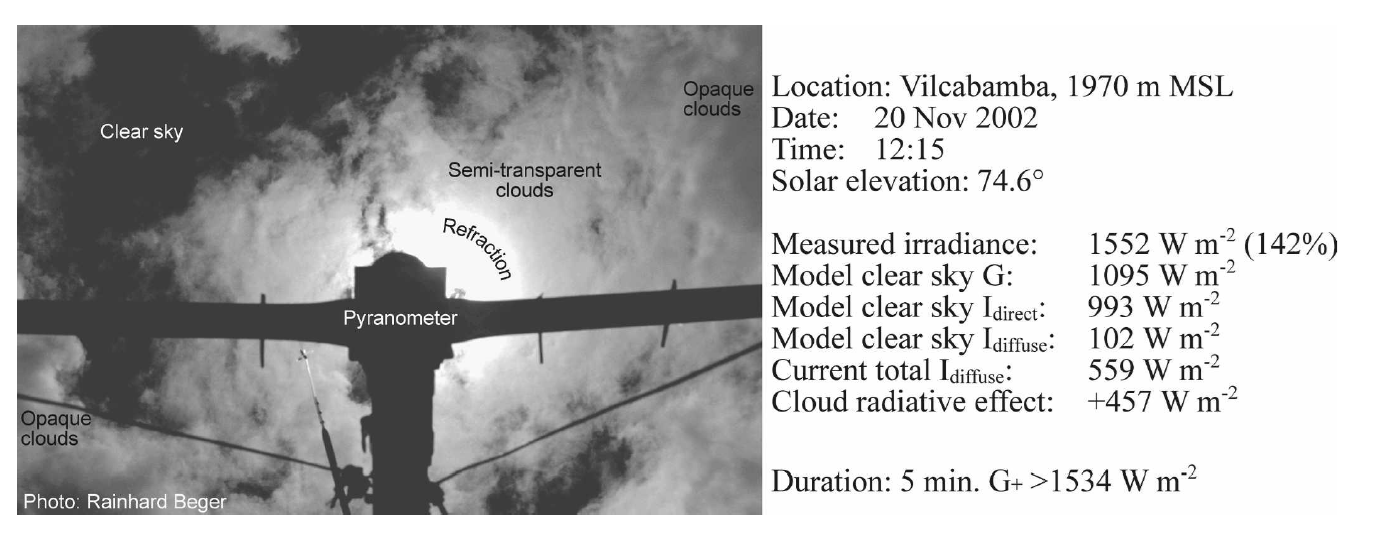
Cloud enhancement (CE), also referred to as overirradiance or irradiance enhancement, is a physical phenomenon where clouds act as lenses and increase the measured GHI above the EHI values, resulting in clearness index values \(K_T > 1\).
Values as high as \(\textsf{GHI}= 1832 ~ \mathsf{W/m^2}\) have been reported 3. Note, however, that cloud enhancement is limited in time, and that the magnitude of the enhancement depends on the measurement time step and on the type of sensor used.
An example of a cloud enhancement scenario from Emck and Richter 3 is shown below:
When importing custom weather data, high Kt sub-values are flagged.
-
NASA. Solar Irradiance Science Earth. URL: https://earth.gsfc.nasa.gov/climate/projects/solar-irradiance/science (visited on 2026-04-15). ↩
-
Greg Kopp and Judith L. Lean. A new, lower value of total solar irradiance: Evidence and climate significance: FRONTIER. Geophysical Research Letters, January 2011. URL: http://doi.wiley.com/10.1029/2010GL045777 (visited on 2026-04-15), doi:10.1029/2010GL045777. ↩
-
P. Emck and M. Richter. An upper threshold of enhanced global shortwave irradiance in the troposphere derived from field measurements in tropical mountains. Journal of Applied Meteorology and Climatology, 47(11):2828–2845, November 2008. doi:10.1175/2008jamc1861.1. ↩↩