Battery voltage model
The voltage model is similar for lead-acid and li-ion technologies.
The base voltage is the open-circuit voltage \(V_\textsf{oc,Battery}\) open-circuit voltage, described separately. In the linear region, the \(V_\textsf{oc,Battery}\) voltage is mainly modified by the Internal resistance. The main difference between technologies is the overcharging behaviour: Gassing phenomenon in Lead-acid, and internal resistance increase in Li-Ion.
The basic model takes the simple form :
For lead-acid batteries, above the overcharging threshold, a gassing voltage correction must be added:
where:
- \(V_\textsf{oc,Battery}\) is a function of SOC, with temperature correction for lead-acid
- ResInt is constant for lead-acid. For li-ion, temperature correction applies, as well as exponential correction in overcharging and deep discharge regions,
- \(V_\textsf{Gassing}\) applies only to lead-acid batteries.
- \(I_\textsf{Battery}\) is positive during charging and negative during discharging.
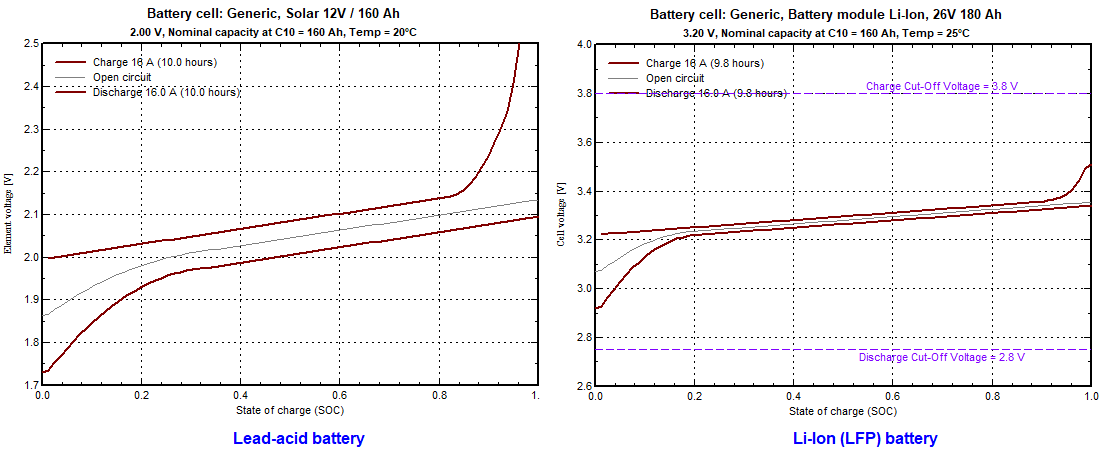
The graphs compare lead-acid and li-ion voltage models for a discharge rate of 10 hours (C10). Ohmic loss is significantly lower in li-ion due to better internal resistance. The gassing curve is visible for lead-acid, and the effect of ResInt increase at high SOC is evident in li-ion. Other characteristics are very similar.
State of charge determination
This model is often used to determine SOC from voltage for charging/discharging control. For a given voltage, SOC determination is highly current-dependent, especially for lead-acid batteries. Lead-acid voltage variation (13.5% for SOC = 0...1) is greater than li-ion LFP variation (4.8%). Additionally, lead-acid voltage is temperature-dependent, which introduces significant measurement uncertainty in field conditions.
Detection of overcharging and deep discharge is facilitated by current deviation enhancements at these extremes. Reconnection must use the \(V_\textsf{oc,Battery}\) voltage curve, which is insensitive to current when the charger or load is disconnected. Therefore, controllers must use a large voltage hysteresis to avoid oscillations.
Polarization
With lead-acid batteries in open circuit, measured voltage is often poorly defined: voltage drift depends on immediately preceding operating conditions. This characteristic time is less than one hour and affects only very-low-current states. PVsyst does not account for this effect.