Battery open-circuit voltage
Basic linear model
Battery operating voltage is based on a simple model with linear voltage evolution as a function of SOC.
Where:
- \(V_\textsf{Nom,Batt}\) is the battery voltage at SOC = 50%,
- \(\alpha\) is the slope, primarily dependent on technology
Nominal voltage
The nominal voltage VNomBatt and the slope of this expression is depending on the technology and the chemistry: the default values are listed below.
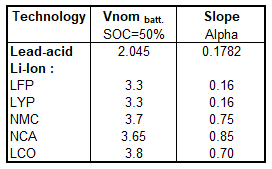
However, these are parameters of the battery definition that can be modified.
NB: Nominal battery voltage is sometimes defined in a simplified way. For example, lead-acid batteries use 2V elements. Battery blocks are 12V, 24V, or 48V. Equivalent LFP battery blocks are 13.2V (4 cells), 25.2V (8 cells), 52.8V (16 cells), or sometimes 49.5V (15 cells).
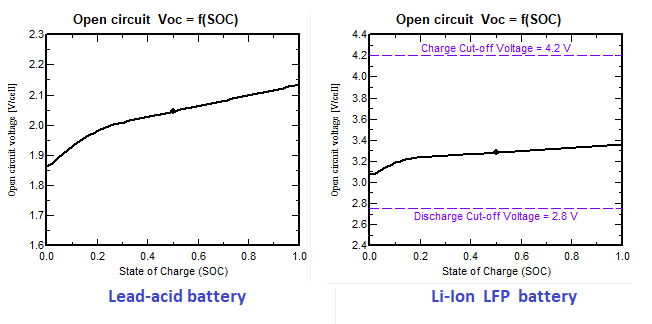
We can see that the behavior is similar for lead-acid and Li-Ion batteries.
Deep discharge correction
Now at very low SOC (below 30% for lead acid, and usually 15% for Li-Ion), we have a derate of this behaviour: the voltage diminishes in a quadratic way, down to a specified minimum voltage at SOC = 0.
where:
- \(dV_0\) = additional voltage drop at SOC = 0
- SOCThresh = SOC threshold for this correction
This Voc diminution is accompanied by an increase of the internal resistance, which still enhances the voltage drop. The exact shape of this correction is of little importance for the behaviour of the system as a whole.
Temperature correction
For lead-acid batteries, battery voltage exhibits linear behaviour, with a decrease of approximately -4 to -5.5 mV/°C per element, as specified in datasheets. Battery parameters define a reference temperature, typically 20°C or 25°C depending on the datasheet.
NB: For proper voltage threshold detection, good controller devices should account for this linear variability. This requires transmitting battery temperature measurements to the controller.
For Li-ion batteries, we do not apply voltage temperature correction. However, internal resistance is corrected for temperature.