Battery ageing
The simulation evaluates battery degradation, which depends on the operating conditions. This degradation can be used for the economic evaluation, or to assess the impact of the battery ageing on the system performances.
Battery degradation is modelled based on two independent processes:
- Static aging, an unavoidable ageing process that occurs regardless of the battery use. When the maximum calendar lifetime is reached, a battery replacement is triggered.
- Cycling aging, a deterioration resulting from usage, depending on the number of charge/discharge cycles and the depth of discharge in each cycle. Cycling progressively reduces the State of Health (SOH), which in turn reduces the effective battery capacity.
These two mechanisms are independent: cycling aging degrades the capacity, while static aging determines when the battery must be replaced — even if the SOH is still above the end-of-life threshold.
Static ageing
A battery is a chemical object, which may be subject to slow degradation along the time. In the database, we usually consider the degradation time as the warranty duration specified by the manufacturer. However this is obviously an extremely uncertain parameter, depending on multiple environmental conditions during the battery use. The battery longevity is usually defined for a reference temperature of 20°C or 25°C.
Lead-acid batteries
In Lead-Acid batteries, the static degradation is mainly related to the sulfatation of the electrodes, and the stratification of the electrolyte (except Gel technologies). It depends on many factors: maintenance, temperature, deep discharges, discharge rate, etc.
Temperature is an important parameter. Most specialists agree that above 25°C, battery static lifetime decreases by a factor of two for every 10°C increase. For example, when kept continuously at 45°C, battery life is reduced by a factor of four. Therefore, in hot climates, the battery should be placed in a location as cool as possible. The question of installing an air conditioning device warrants analysis; it could be activated only during the day when PV production is available.
Li-Ion batteries
Many Li-Ion datasheets mention a warranty of 10 years. We don't have any information about the Li-Ion batteries degradation according to the temperature. These are probably less sensitive to the operating temperatures. The manufacturers often specify a maximum operating temperature of 45°C to 50°C.
Model
The effective battery age AgeBatEff tracks the temperature corrected battery age:
where:
- \(\Delta t\) is elapsed time
- \(T_\text{batt}\) is the battery temperature [°C]
- \(T_\text{ref} = 25\ °C\) is the reference temperature
- \(\alpha = \ln(2)/10 \approx 0.0693\ °C^{-1}\), corresponding to a doubling of the aging rate for every 10 °C increase above reference (Arrhenius approximation)
!!!. NB Static aging does not reduce the SOH. It acts as an independent replacement criterion based on time and temperature.
When the effective age reaches the maximum calendar lifetime defined in the battery parameters, a battery replacement is triggered.
Cycling aging
During battery operation (charging and discharging) degradation occurs, leading to a gradual reduction in the available capacity. This degradation is represented by the battery State Of Health (SOH)
State of Health (SOH)
The SOH is a value between 0 and 1 that represents the fraction of nominal capacity still available:
As the battery is cycled, the SOH gradually decreases and the energy the battery can store and deliver is reduced accordingly.
Number of cycles
Datasheets usually specify a maximum number of cycles, for a specified depth of discharge (DOD). The end of life (EOL) corresponds to a diminution of the capacity, usually down to 80% of the nominal capacity.
A cycle is always defined as a complete charge and discharge of the battery:
where:
- \(|\Delta E_\text{SOCbalance}|\) is the energy discharged during the time step [Wh]
- \(Capa_\text{ref}\) is the nominal capacity [Ah]
- \(V_\text{nom}\) is the nominal battery voltage [V]
- \({SOH}\) : State of health [%]
!!!. NB When the SOH decreases, the battery cycles faster for a given internal energy variation
The battery SOH variation is computed based on the current fraction of cycle \(\Delta N_\text{cycle}\) on the total number of cycles \({N_\text{cycle,max}}\)
Total number of cycles
The total number of cycles a battery can achieve before reaching its EOL may sometimes depends on the battery current SOC. Usually, a battery is capable of performing less cycles with a high SOC variability than a low SOC variability. This information is represented by the number of partial cycle as an function of DOD:
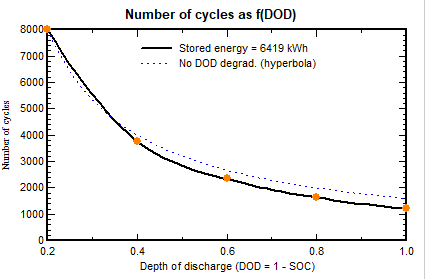
A perfectly hyperbolic function means the current SOC (or DOD) as no influence on the total amount of energy storable in the battery. If the function decreases faster with the DOD than the hyperbole function, this means that a higher depth of discharge reduces the battery lifetime.
e.g: Two identical batteries (A and B). Battery A is allowed to discharge until 60% SOC, the other until 20%. On partial cycles of battery A (100% \(\rightarrow\) 60% \(\rightarrow\) 100%) is equivalent to 1/2 partial cycle of battery B (100% \(\rightarrow\) 20% \(\rightarrow\) 100%).
If the function is a hyperbole, Battery B will be able to perform half the partial cycles of battery A, for a same number of full cycles If the function decreases faster, battery B will perform less than half the partial cycles, for a lower number of full cycles.
In reality, other factors may influence the maximum number of cycles, such as the charging and discharging rate and the cells temperatures. These effects are not taken into account in the SOH computation.
End of life
When the SOH reaches the end-of-life threshold (SOH_EOL, typically 80%), the battery has reached the end of its useful life as defined by the manufacturer. It triggers a battery replacement.
Initial state
At the start of a simulation, the battery aging state can be initialised as either a new or pre-aged battery:
| Parameter | Default | Description |
|---|---|---|
| SOH | 1.0 | State of Health at simulation start |
| Effective age | 0 | Temperature-corrected calendar age already accumulated |
Setting non-default values allows simulating a battery that is already in service.
Output variables
The following aging variables are available in the simulation results:
| Variable | Description |
|---|---|
| SOH | State of Health at each time step |
| Equivalent cycles | Cumulative number of equivalent full cycles |
| Effective age | Temperature-corrected calendar age |
All of these variables are given at the end of each time step.
!!!. Before PVsyst 8.1.4 Before PVsyst 8.1.4, the battery SOH was called SOWcycle (state of wear) and the battery effective age was called SOWstatic The SOWstatic was defined as a percentage of the battery max age The battery capacity was not influenced by the SOWcycle nor the SOWstatic