Resampling
Weather data is not always available, or needed, at the time step you actually want to work with. Resampling is the mechanism PVsyst uses to convert a weather time series from its original time step to a coarser one, for example turning a 1-minute file into a 5-minute or 15-minute file.
Resampling can take place:
- At import: when the underlying source provides data at a finer resolution than the requested MET file. For instance, generating a Meteonorm or Synthetic 5-minute or 15-minute weather file relies on an underlying 1-minute synthetic series, which is then resampled down to the requested time step.
- At simulation time, when a simulation is run (via the advanced simulation dialog) at a coarser time step than the resolution of the source
.METfile, for example a 15-minute simulation using a MET file whose original data is at 1-minute resolution.
Resampling a weather file creates the variables used by the sub-hourly clipping correction model: the maximum GHI, the minimum GHI, and the number of time steps above or below the clipping threshold. Storing these statistics at resampling time is what allows the clipping correction to be applied automatically on a resampled sub-hourly file.
Rules
The new time step must satisfy several constraints:
- It must be larger than, and a multiple of, the original time step (e.g. 5-minute → 15-minute is allowed, 10-minute → 15-minute is not).
- It must be a divisor of 60 minutes (e.g. 1-minute → 6-minute is allowed, 1-minute → 7-minute is not).
- It cannot exceed one hour.
Warning
Sub-hourly resampling cannot be performed twice. If you need several weather files at different time steps, always start from the original file with the smallest time step.
Variables
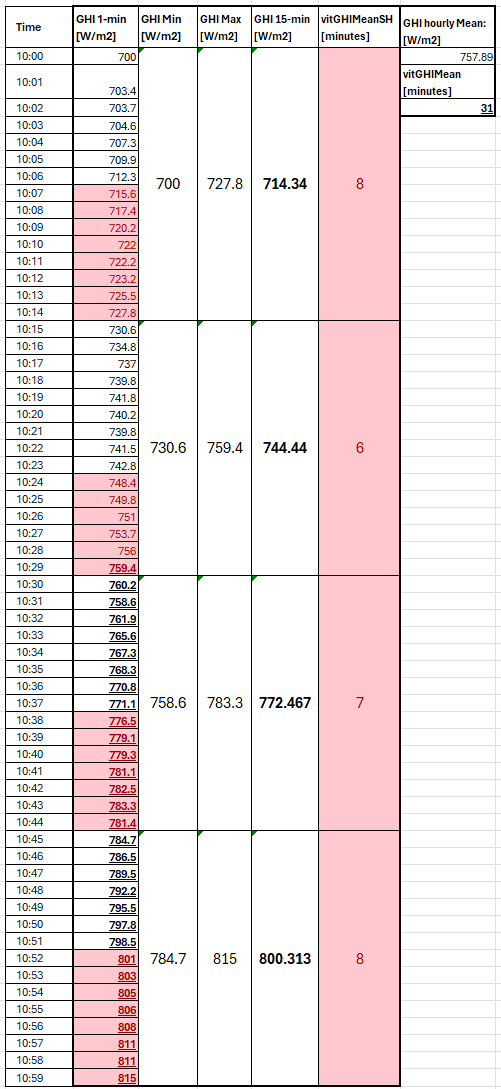
When resampling, the input variables are averaged to compute the new values. Resampling also preserves information about the irradiance variability needed for the sub-hourly clipping correction:
- The minimum and maximum GHI among the original time steps making up the new interval.
- The time above hourly average (
vitGHIMean): the number of original time steps whose GHI is above the hourly GHI average. - The time above sub-hourly average (
vitGHIMeanSH): the number of original time steps whose GHI is above the new time step's own GHI average.
Example: GHI min, max, and time-above-average computation when resampling 1-minute data to 15-minute data. Initial GHI values above the 15-minute average are highlighted in red; initial GHI values above the hourly average are underlined. Note that vitGHIMeanSH does not add up to vitGHIMean.
Updates
8.1.5
Resampling was introduced in PVsyst version 8.1.5. Resampled files — in particular Meteonorm 5-minute and 15-minute files — are not backward compatible.