Provider comparison
PVsyst gives access to many weather data sources.
These show that the available weather data are far from being an exact science. There are big discrepancies between these databases, and it is very difficult to estimate which one is the best suited for a given project or location, and what is the probable error.
We have performed a comparison between several sources for different locations to provide a better understanding of how weather data can vary across sources.
Comparisons cannot be made rigorously, because of the variety of conditions:
- Not all sources are available for every spot on the globe. Some of them are for given locations, other ones perform interpolations or are for discrete grids of variable sizes.
- Climate variability: the sources apply for measurements of given years, or averaged periods which differ from one source to another (or even for one location to another, depending on historical measurements availability)
- Measurements: The analysis and validation of ground station data or satellite images involve sophisticated models which are constantly evolving and improving. The methods and techniques may vary from source to source.
For the comparison, we have chosen as reference the annual available irradiation [kWh/m²/year]. This parameter is relevant for PV grid systems, as the PV output is quasi-linear with the solar energy input.
Comparison between several data sources for different continents
The following figures present a comparison of four free weather data sources available in PVsyst across nine locations on different continents. Multiple versions of each data provider are included, highlighting not only the differences between providers but also the variations that can occur between versions from the same provider. Weather data providers continuously update and refine their databases and algorithms, as well as expand the temporal coverage of their datasets.
The graph shows the deviation from the average at each location in percent. The average has been performed over all sources without any weighting. Each site’s climate classification (KGPV) is indicated next to the city name.
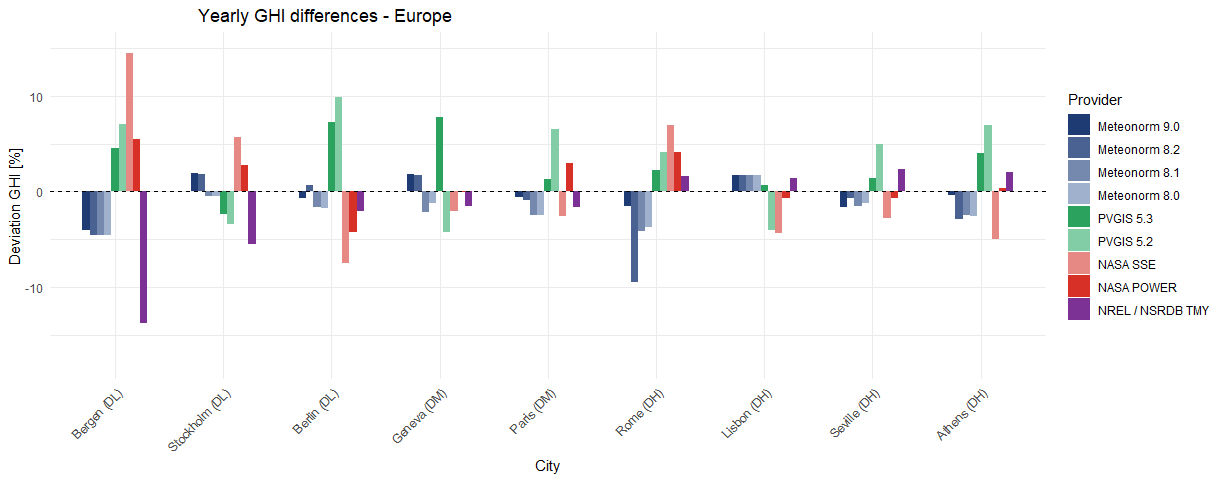 Comparison of different data sources for several sites in Europe.
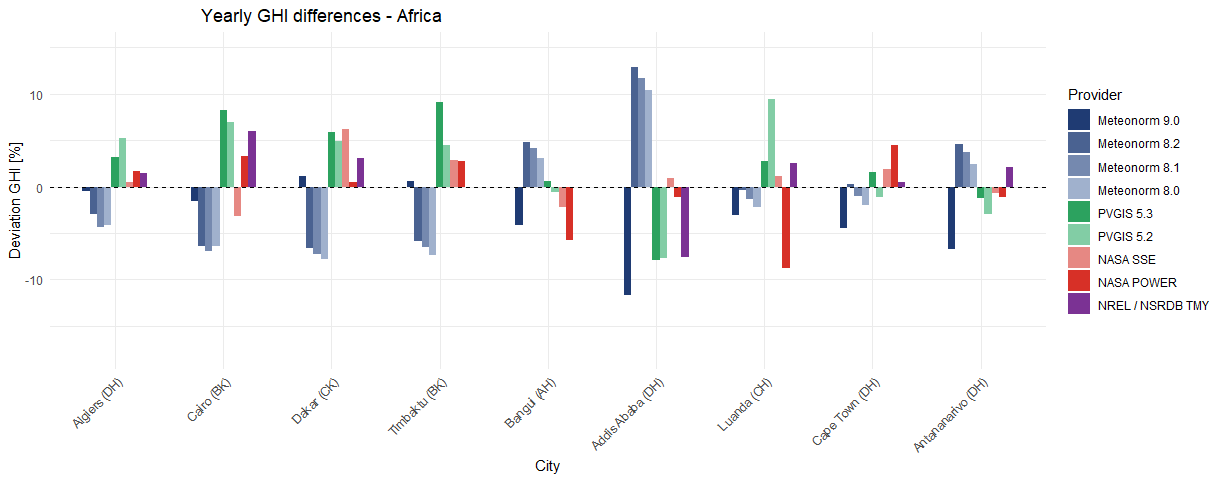 Comparison of different data sources for several sites in Africa.
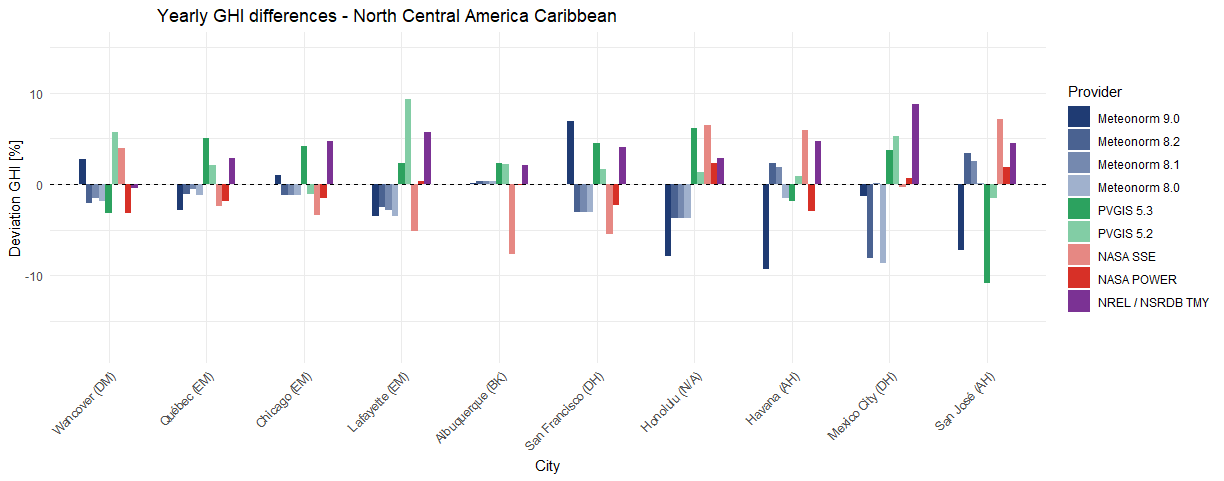 Comparison of different data sources for several sites in North, Central America and Caribbean.
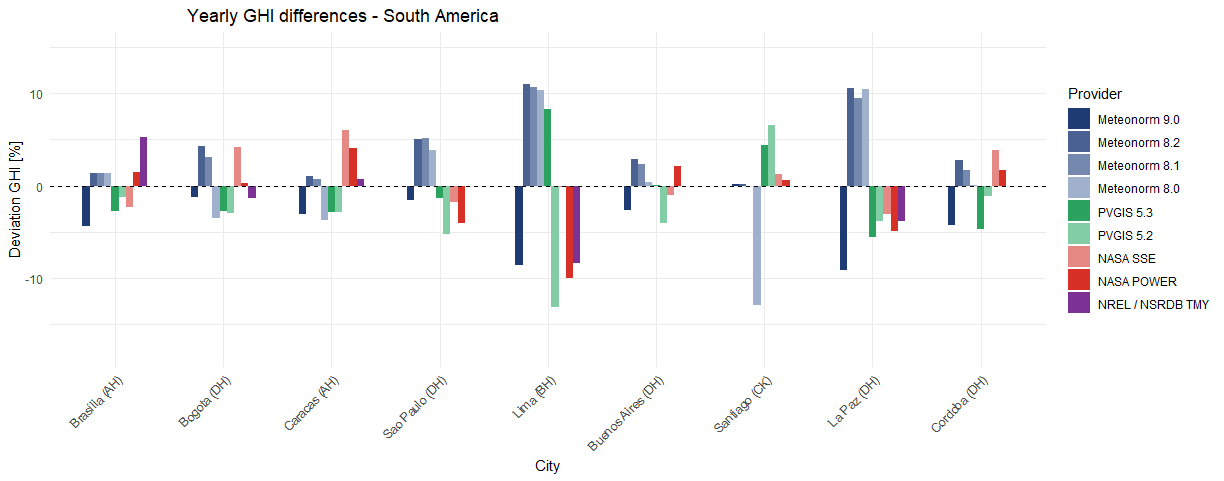 Comparison of different data sources for several sites in South America.
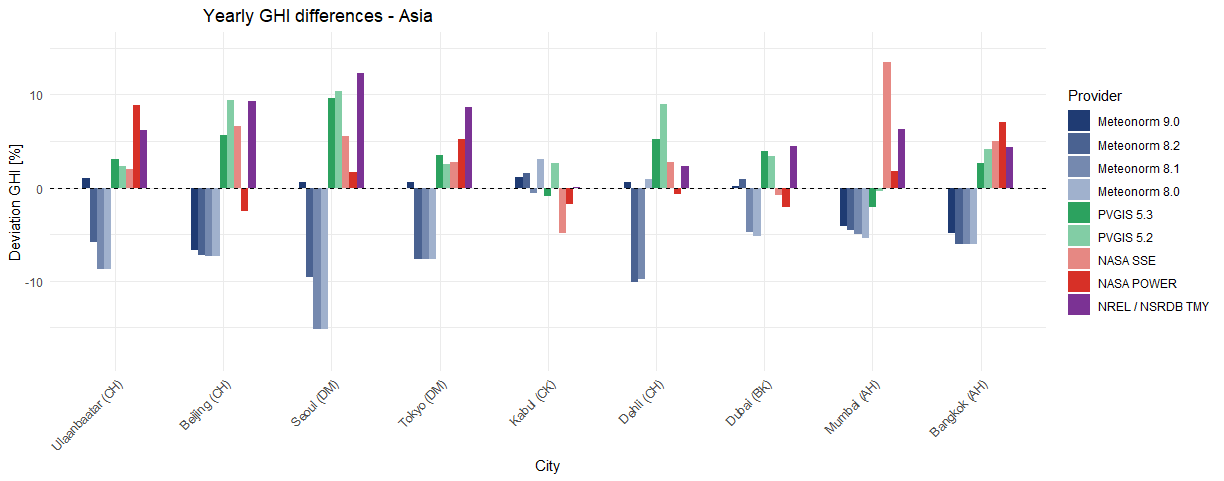 Comparison of different data sources for several sites in Asia.
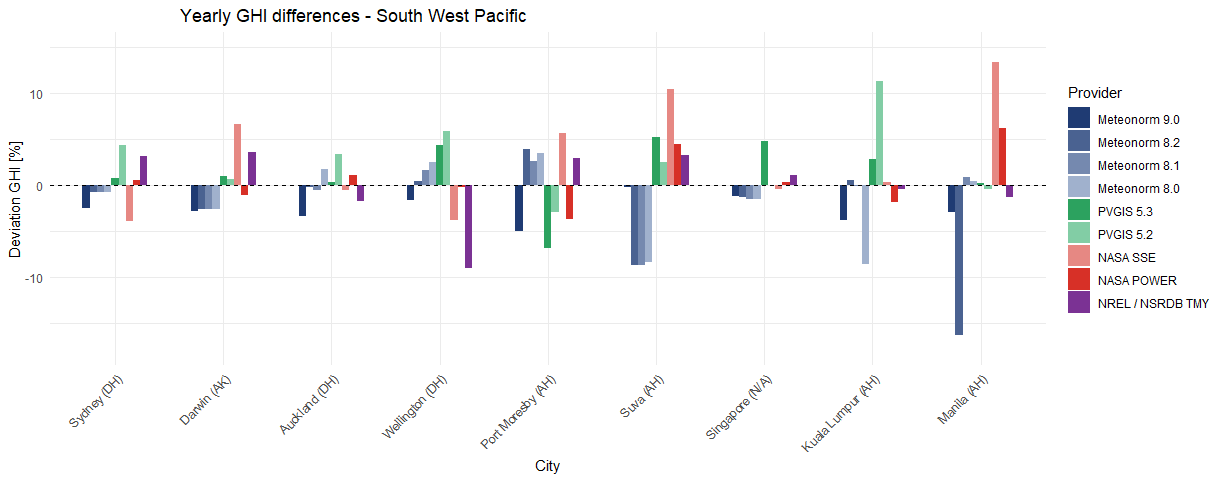 Comparison of different data sources for several sites in the South West Pacific.
A few conclusions can be drawn from the graph:
- Different sources typically concur within 10% of the mean value, demonstrating a high degree of agreement in most cases.
- It is challenging to determine which source most accurately represents reality, especially given that no one can reliably predict future climate changes.
- The variability and uncertainties in data from each source exhibit regional dependencies, suggesting that geographic and environmental factors significantly influence measurement discrepancies.