Controllers - Main interface
Although sophisticated regulation modes can be used in some photovoltaic systems (proportional regulators, partial field cuts, for example), the type of regulator currently available in PVsyst operates only on an "On/Off" basis.
Its decisions are based on the modelled battery voltage. Each action is characterised by two thresholds - starting and stopping - which can be given either in specific values by element, or for the whole battery.
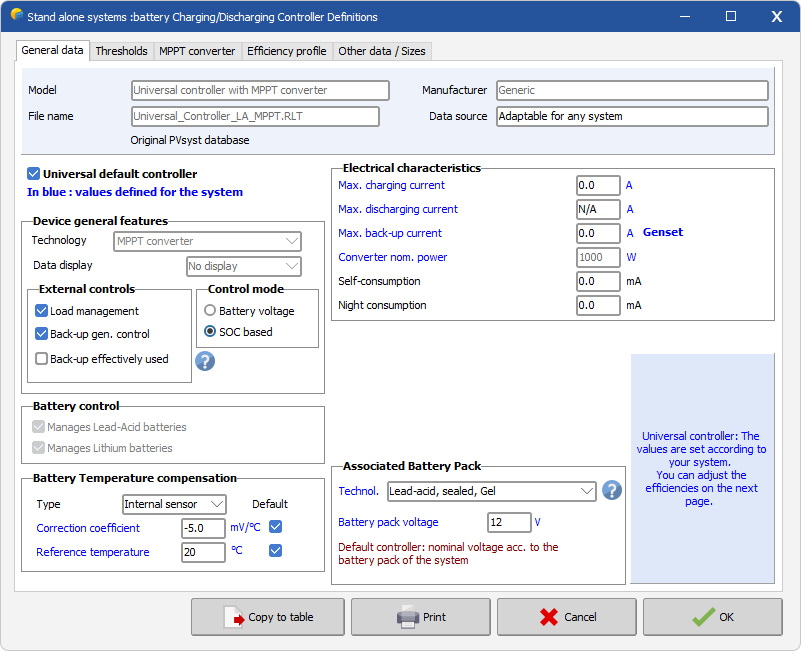
Controller parameters
Besides identification as in other components (model, manufacturer, etc.), the controller parameters include:
- Technology and data display specifications. These are only informative parameters, except that MPPT or DC-DC converters are specified by the "Technology" choice.
- Charging thresholds, for which default values proposed by the program depend slightly on battery technology.
- Discharging thresholds are the regulator settings controlling load disconnection and ensuring battery protection against deep discharge.
- Temperature compensation (linear) is available with some regulators, especially recommended for use in warm climates. Some controllers have an internal sensor (measuring their own temperature), while others have an external sensor to measure battery temperature.
- Maximum input and output currents are among the most important real device characteristics. Before simulation, the program checks the consistency of the controller choice with system characteristics.
- Associated battery pack: most controllers are suited for one, or sometimes two switchable, battery voltages. The simulation process must know this switch position and updates it at simulation time. Since thresholds depend slightly on battery technology, we must define them here.
- Back-up generator management is rarely available with small PV systems. When controlling a back-up generator, the logical hierarchy of thresholds must obviously be respected: for example, the generator's starting threshold should not be as low as the deep discharge protection threshold. The program rejects erroneous configurations and produces an error message.
Thresholds
Until version 6.39, operating thresholds were defined as battery pack voltage, which has a high dependency on battery voltage (depending on temperature, current, and the model).
Now PVsyst also allows defining thresholds in terms of SOC and offers a detailed tool for the relationship between SOC and voltages.
To decide on threshold adjustment, it is useful to examine the battery voltage curve according to state of charge. One advantage of PVsyst's detailed simulation is that it allows in-depth study of battery behavior and lifetime as a function of the control thresholds chosen.
MPPT or DC-DC converter
Some PV systems use a Power Converter for better matching of PV-array characteristics to the user voltage (usually battery voltage). In PVsyst simulations, the parameters defining this optional power conversion unit are part of the regulator device.
Universal controller
When using commercially available controllers, the program checks whether it is suited to the system properties.
However, in the early stage of system study, the exact regulation strategy is not critical. That is why we introduced a general-purpose universal controller, which automatically matches system characteristics. This allows you to perform initial system simulations without defining a specific controller device.