Basic data page (Lead-Acid)
Battery identifiers
As for any PV component:
- Model and Manufacturer will appear in the batteries choice lists.
- Data source usually refers to the source of the data (most often the Manufacturer, but may be an independent institute or your own measurements).
- File name should have the extension '.BTR'
Technology (lead-acid)
- Technology specifies vented or sealed (without maintenance) batteries, and tubular / plates / vehicle starting technologies.
- All Lead-acid batteries are made of 2V-elements in series. For capacities below 200 Ah, these are blocks of 12V (sometimes 24V or 6V). Above 600 Ah, these are single 2V elements, their weight may attain 50 kg or more per element.
Basic parameters
Contains the most important battery specifications present on any manufacturer data sheet. These values may be defined either by cell, or for the whole battery.
- Number of elements in series,
- Nominal voltage: is always 2V per element for lead-acid batteries.
- Nominal capacity: the reference capacity is specified for a discharge rate of 10 hours (noted C10) and a reference temperature of 20°C. Capacity behavior according to discharge rate and temperature will be defined in the next sheet.
- Internal resistance is considered to be constant in lead-acid batteries. If not specified you can ask for a reasonable default (i.e. a voltage drop of 40 mV per cell at C10, modifiable in the Advanced Parameters).
- Reference temperature is the reference temperature used by the model to set 2 corrections: the Open Circuit Voltage correction as a function of temperature, and the capacity correction as a function of temperature. It is usually 20°C. Be careful, modifying this reference has an effect on the battery voltage, and therefore on the controller ON/OFF thresholds when defined in terms of voltage.
- Coulombic efficiency (or faradic or current efficiency), is the discharge/charge cumulative currents balance, in [Ah]. This is approximately 97% for lead-acid batteries. In the model, this efficiency is applied to the charging current.
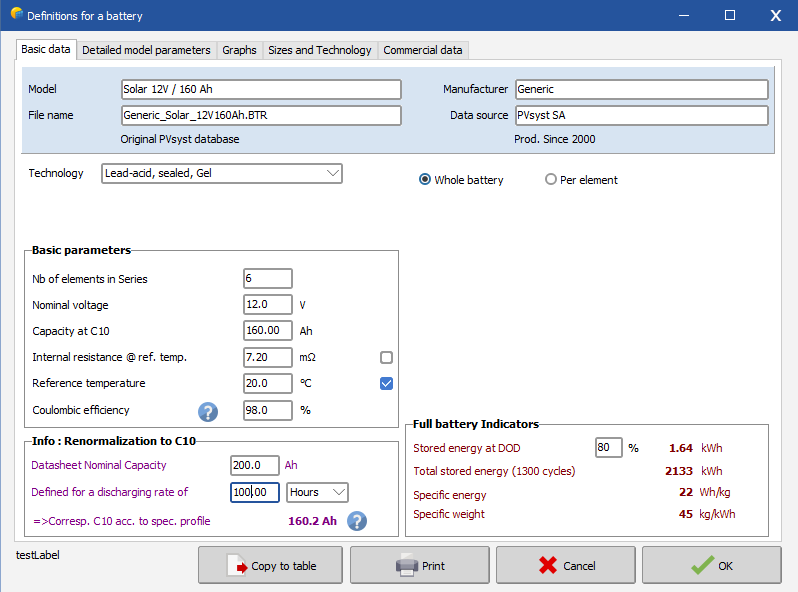
Renormalization to C10 tool
The nominal capacity may be defined for a different discharge rate on the datasheets. This tool allows you to recalculate the PVsyst nominal value at C10 from this value and the capacity variability according to the discharge rate. For solar lead-acid batteries, some manufacturers specify the capacity as C100. This represents a value approximately 30% to 40% higher than the reference capacity used in PVsyst, which is specified for C10. NB: This tool provides the value to be defined as "Capacity at C10", but it does not replace the value; you must do that explicitly.