Irradiance and Solar Geometry
Irradiance is a measure of the power of electromagnetic radiation received per unit area. It is expressed in watts per square meter (W/m²) and represents the density of incident radiation, such as solar radiation, on a surface. It varies continuously depending on atmospheric conditions, the time of day, and the position of the Sun in the sky.
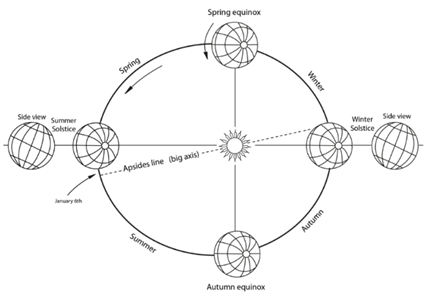
Solar geometry describes the position of the Sun relative to an observer on Earth. This position varies throughout the day due to the Earth’s rotation, and throughout the year due to the tilt of its axis and its revolution around the Sun.
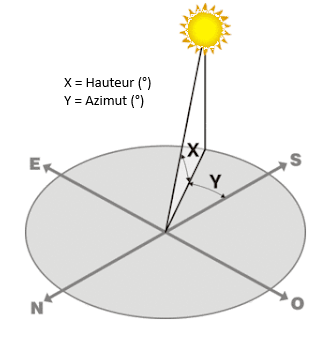
Key angles such as solar altitude (height above the horizon), solar azimuth (direction of the Sun relative to the cardinal points), and solar zenith angle (angle between the Sun and the vertical) describe the Sun’s position in the sky at any given moment.
irradiance and solar geometry
This diagram shows the sun's path across the sky throughout the year.
Solar diagram
Key points:
- The curves show the sun’s path at different times of the year
- The closer you are to the equator, the higher the sun rises in the sky
- Geneva: max ~67° (summer) / ~21° (winter) • Cairo: max ~83° (summer) / ~37° (winter)