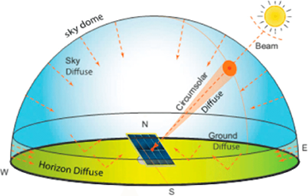
Components of Irradiance
The solar radiation reaching a photovoltaic module consists of several distinct components that, together, define the total irradiance received by a surface. Understanding these components helps explain why a module’s orientation and environment influence its performance.
Direct irradiance (direct rays): This is solar radiation that travels in a straight line from the Sun to the surface without being scattered. It is the most intense component and varies depending on the Sun’s position and the transparency of the atmosphere.
Circumsolar irradiance: This refers to solar radiation scattered by air molecules or aerosols near the Sun, forming a luminous halo around the solar disk. It is part of the forward-scattered radiation and behaves similarly to direct radiation from the perspective of the module’s orientation.
Diffuse irradiance: Solar radiation scattered in all directions by clouds, dust, and atmospheric molecules. This radiation reaches the module from the sky rather than directly from the Sun, making it less dependent on the module’s tilt.
Reflected irradiance (albedo): Solar radiation that reaches the ground, nearby structures, or other surfaces and is then reflected toward the module. The intensity of this component depends on the reflectivity (albedo) of the surrounding surfaces.
The total irradiance received by a module is the sum of these different components. Each of them reacts differently to the module’s tilt and orientation.