Modules
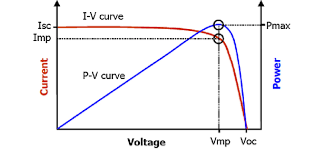
A photovoltaic module is a set of solar cells connected and assembled to produce usable electrical power. While an individual cell generates only a low voltage, connecting many cells in series allows the module to provide the higher voltages required for practical applications. The module’s electrical behavior is described by its I–V curve, which indicates the current it can produce for different voltage values. The point on this curve where the product of voltage and current is maximized is called the maximum power point.
The performance of a photovoltaic module depends on both the properties of its cells and the surrounding conditions. The module’s design and materials—such as the number of cells, the wiring configuration, and the encapsulation—influence the amount of light absorbed as well as the efficiency of collecting the generated charges. At the same time, external factors such as irradiance, temperature, and spectral composition influence the module’s performance relative to its nominal values defined under standard test conditions.