Positive displacement pump
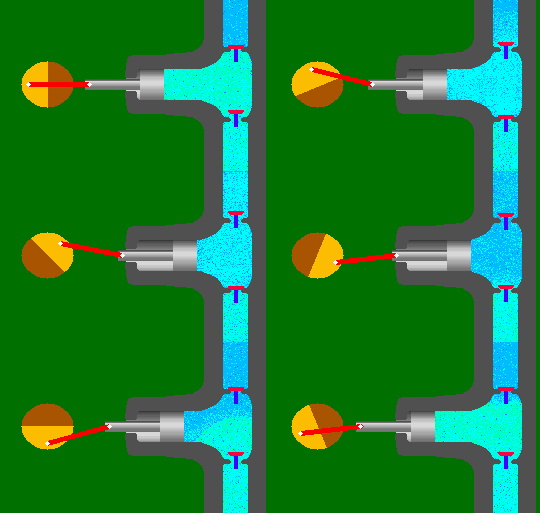
Positive displacement pumps operate on a different principle than centrifugal pumps: they displace a fixed volume of water with each mechanical cycle.
1. Operating Principle
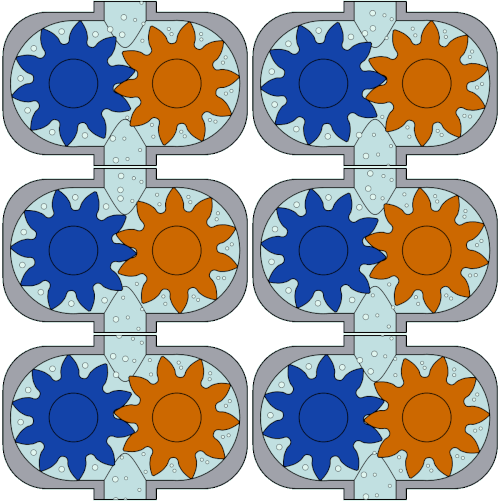
In this type of pump, the rotor performs an eccentric motion inside a stator.
As it rotates, the rotor creates chambers of variable volume:
- on one side, the volume increases → this causes water to be drawn in;
- on the other, the volume decreases → the water is compressed and then discharged toward the outlet.
Thus, with each rotation, a specific amount of water is trapped and then pushed through the pump.
2. Consequences of Positive Displacement
This positive displacement mechanism offers two significant advantages:
1. Efficient pumping even at low speeds
Unlike centrifugal pumps, the positive displacement pump continues to deliver water even at very low rotational speeds. → Flow rate depends primarily on the volume displaced per cycle, not on speed.
2. Ability to generate high pressure
Since the water is compressed directly within the chambers, the pump can generate high pressures. → It is therefore suitable for delivering water to great heights (high manometric head).
A positive displacement pump compresses and displaces a volume of water with each rotation thanks to the eccentric rotor-stator motion. It remains efficient at low speeds and can reach high pressures, making it ideal for pumping to great heights.