Centrifugal Pump
Centrifugal pumps are part of the larger family of turbopumps. They operate by converting the mechanical energy supplied by a motor into hydraulic energy that is transferred to the fluid.
1. How a centrifugal pump works
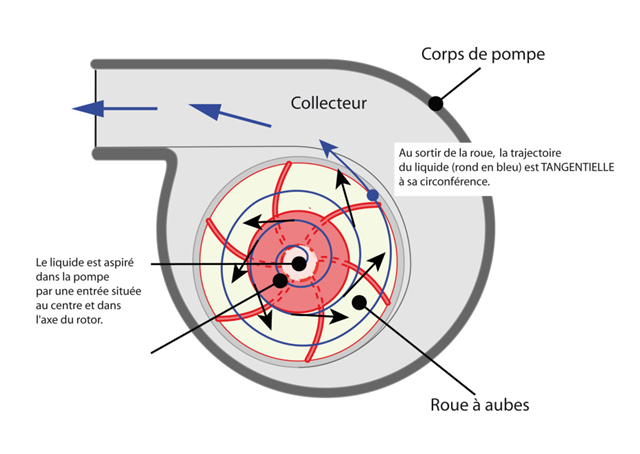
A centrifugal pump consists mainly of:
- an impeller (rotor) equipped with blades,
- a pump housing that guides the fluid,
- a diffuser (diffuser or volute).
Step 1: Setting the fluid in motion
The impeller rotates thanks to the motor. The fluid entering the center of the impeller is captured by the blades, then driven into a circular motion.
The rotation gives the fluid kinetic energy: its velocity increases significantly.
Step 2: Converting velocity to pressure
As it exits the impeller, the fluid is moving very fast. It then passes through a component called a recovery chamber:
- diffuser (fixed diverging channels)
- or volute (snail-shaped housing)
In this area, the flow cross-section increases, so the fluid’s velocity decreases.
According to Bernoulli’s principle, the decrease in velocity results in an increase in pressure. This is how the pump provides the pressure needed for delivery.