Kirchhoff's Laws (Nodes and Loops – Basic Level)
Kirchhoff's laws are two very simple rules that follow from the principles of conservation:
- conservation of electric charge → node law,
- conservation of energy → loop law.
They allow us to analyze virtually all electrical circuits.
1. Node Law (currents)
A node is a point in the circuit where several conductors meet.
The node law states:
The sum of the currents entering a node is equal to the sum of the currents leaving it.
In other words, current does not accumulate at the node: everything that goes in comes out.
We can write this simply as: \(I_{\mathsf{incoming\ total}} = I_{\mathsf{outgoing\ total}}\)
At a node:
- a current of \(2\ \mathrm{A}\) enters from the left,
- a current of \(1\ \mathrm{A}\) enters from the top,
- a current exits to the right.
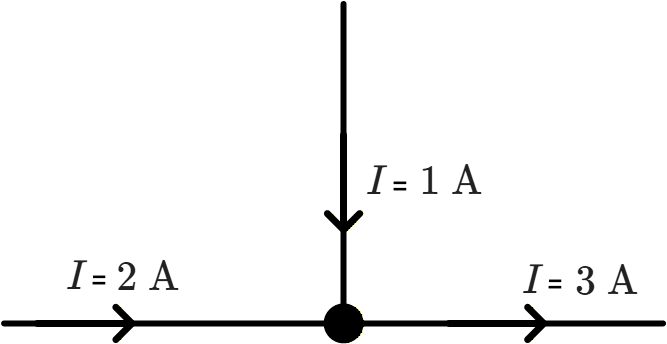
Then the current leaving to the right is: \(I_{\mathsf{right}} = 2\ \mathrm{A} + 1\ \mathrm{A} = 3\ \mathrm{A}\)
2. Mesh Law (Voltages)
A mesh is a closed loop in a circuit: you start at a point, follow the conductors, and return to the starting point.
The mesh law states:
In a mesh, the algebraic sum of the voltages is zero.
In simpler terms:
The voltage supplied by the source is equal to the sum of the voltage drops across the circuit components.
Simple series example:
A \(12\ \mathrm{V}\) battery powers two resistors in series.
We measure:
- \(7\ \mathrm{V}\) across the first resistor,
- \(4\ \mathrm{V}\) across the second,
- \(1\ \mathrm{V}\) across the third.
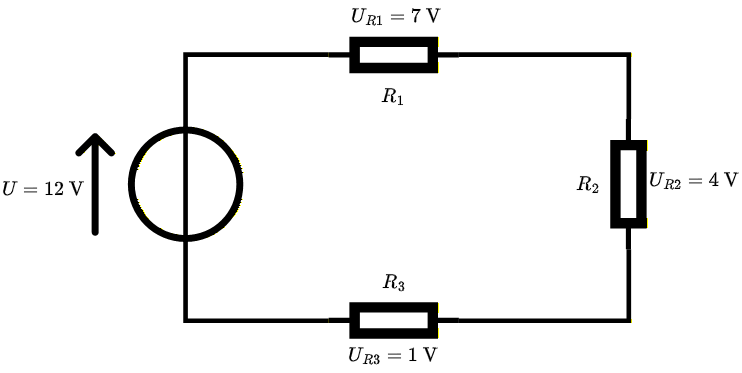
We verify Kirchhoff’s loop law:
Key Points
Node Law (currents)
- At a node, all incoming current flows out.
- The sum of the incoming currents is equal to the sum of the outgoing currents.
- We can write: \(I_{\mathsf{incoming\ total}} = I_{\mathsf{outgoing\ total}}\)
Loop Law (voltages)
- In a closed loop, the voltage supplied by the source is equal to the sum of the voltages across the circuit elements.
- For a source \(U_{\mathsf{supply}}\) and voltage drops \(U_1\), \(U_2\), …: \(U_{\mathsf{supply}} = U_1 + U_2 + \cdots\)
- These laws reflect the conservation of charge (nodes) and energy (loops).
Equivalent Resistance Calculator
1) Node Law
The sum of the incoming currents equals the sum of the outgoing currents: \(I_1 + I_2 = I_3\)
2) Mesh Law with Two Resistors in Series
In a series circuit: \(U_{\mathsf{supply}} = U_1 + U_2 = R_1 \times I + R_2 \times I\)