Energy and Electrical Power
In the International System of Units (SI), energy is measured in joules. One joule corresponds to the work done by a force of one newton acting over a distance of one meter.
Energy can be defined as the ability to do work. The work done (i.e., the energy) per unit of time is called power, and the unit of power is the joule per second, or watt. The unit of energy commonly used in electrical engineering is the watt-hour. Note, therefore, that \(\mathrm{W}\) is a measure of power, while \(\mathrm{Wh}\) is a measure of energy.
It is important to understand the difference between power (\(\mathrm{J/s}\) or \(\mathrm{W}\)) and energy (\(\mathrm{J}\) or \(\mathrm{Wh}\)). The difference between power and energy is similar to that between speed and distance. Speed is the distance traveled per unit of time (for example, \(\mathrm{m/s}\)), just as power is the energy transferred per unit of time (\(\mathrm{J/s}\)).
If you ride a bike up a hill, you will have traveled the same distance by the time you reach the top, regardless of your speed. The same applies to energy: whether you reach the top after 10 minutes of effort or after 1 hour, you will have consumed the same amount of energy, but at a different power.
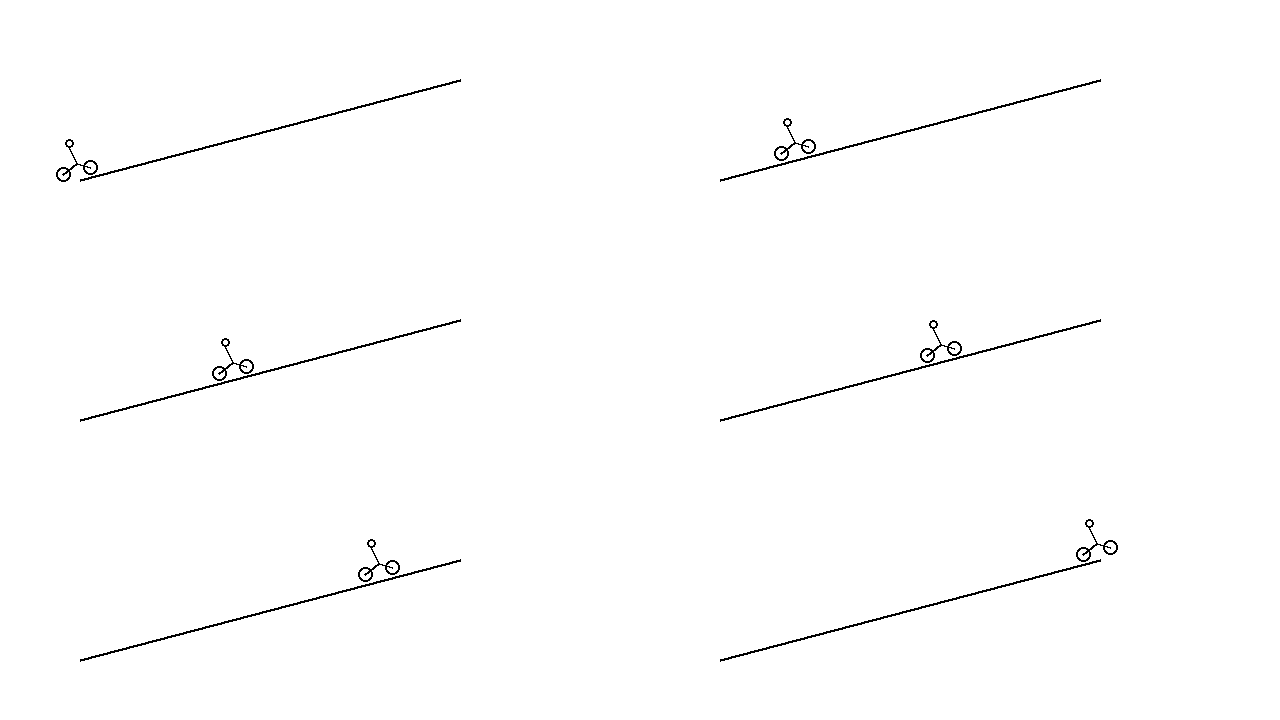
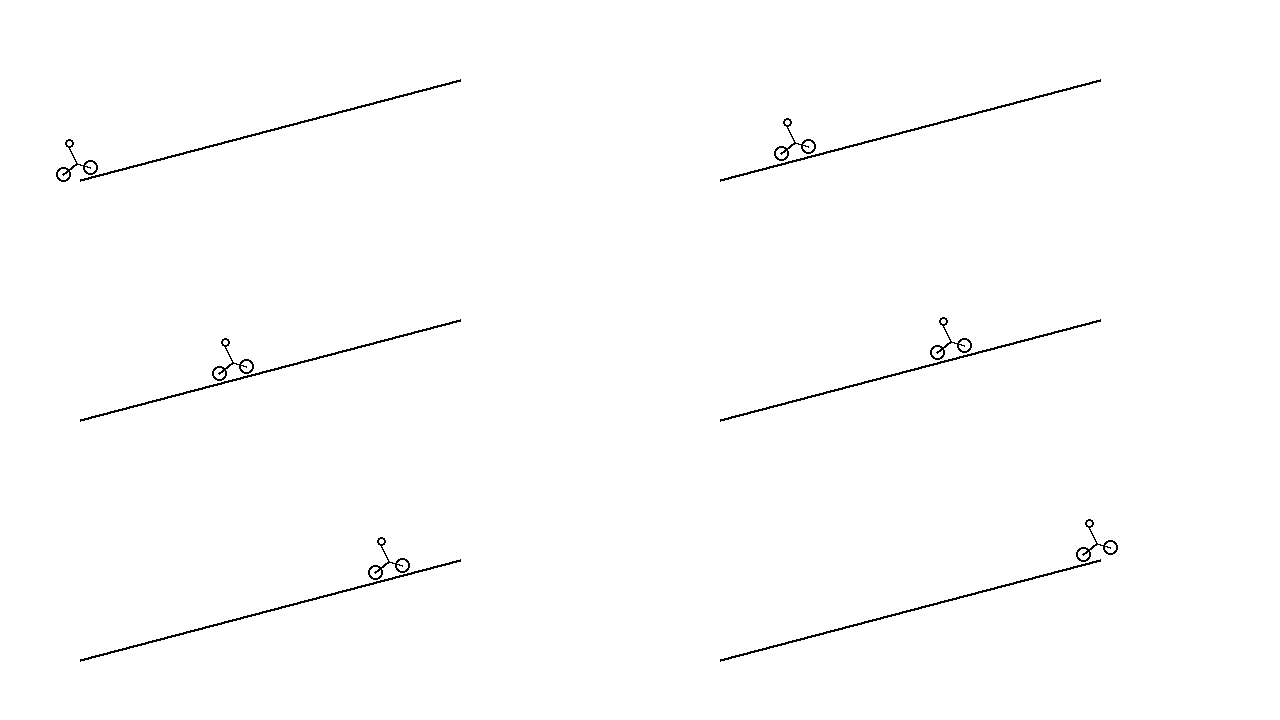
$\mathbf{600\ \mathrm{Wh}}$ in both cases
Energy Supply
Enter the number of kWh and the number of devices with the specified power; the calculator will determine how many hours the devices can be used.